Monday, June 30, 2008

Long Reining: Experiment #1

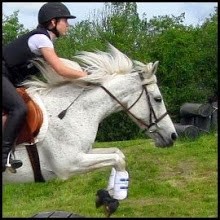
Okay, so instead of writing about tonight's jumping lesson (which involved very little jumping as the mare was a few fruit loops shy of a full bowl), I'll tell you about experiment #1 with long reining. I'll tell you about my lesson once I'm a little more cheerful about the situation. Especially since I just spent a post talking about how wonderful she is and how we're thinking of breeding her. How ironic.

In any case, here's the story of the long reining extravaganza. I just finished reading Philippe Karl's book on long reining, which I highly recommend. It's very concise, easy to understand, and has the aids nicely explained along with beautiful photographs to illustrate. It was a joy to read.

Some minor equipment issues that I was already aware of:
  • Our longeing caveson is too big for her. This is because we bought it for Bailey, who had a Thoroughbred-sized head, and McKinna has pony-sized head. It doesn't slip wildly around, but it's not snug.
  • I don't have long reins. Ideally you want about 5 feet of round cord with snaps at one end, and the other end of the cord tapers out into many many more feet of flat cotton line. I used longe lines, one on each side. They didn't slide very well through the rings on the caveson, but they worked passably.
  • We don't have a surcingle. I borrowed a friend's, so that wasn't too bad.
Said equipment issues should hopefully be fixed soon, since my mom just ordered a nice pony-sized leather caveson. Next item on the list is some nice long reins, and finally a surcingle. Aren't new equestrian ventures fun?

So the pony (who was, unlike her resistant self tonight, quite cheerful that night) stood patiently while I set up a longe line on each side. On the inside, you run the line through the bit and clip to the surcingle; for the outside, you run it over their back, through the surcingle, and clip to the bit. That way the inside line is softer and acts as an opening rein instead of a direct rein, which can cause resistance for the horses that aren't used to it yet.

So up we hooked and away we went!

It was a bit laughable, to tell the truth. We just did walk-trot-canter on a circle, with me trying to coordinate two longe lines and one whip (three hands would have been nice) and her trying to figure out what on EARTH I wanted her to do (hence title: misadventures). Since my saintly horse knows full well what to do on the longe line, she just trucked around trying to listen to the reins. It worked pretty well, though I have a feeling that our communication will vastly improve with proper long reins.

I think I will wait to try again until I have at least a proper caveson. I'll continue just working her on a big circle until I have the right equipment, she's a little more comfortable with it, and I'm more familiar with handling that much stuff at once. After that, we'll switch to direct rein on both sides and start practicing me driving her from different directions, moving to a change of rein at the walk (where she's bent in one direction, then as I cross behind her she switches the bend as she moves in the new direction of travel).

I figure if I can get to where we are proficient at shoulders-in reversed and shoulders-in, that's pretty good. If I can get to the elementary stage of half-pass (which is like shoulders-in reversed, only they are bent to the inside), I will be pleased as punch. Shoulders-in is an immensely beneficial exercise, and I think doing it from the ground will be very, very good for both of us. First, it removes a complication by taking the rider off the horse, making it easier for the horse to balance itself. Second, since for that exercise alignment is crucial, being on the ground lets you very easily see whether your horse is doing it properly. Third, since you don't have seat or leg aids, you need to break it down for your horse and get your horse responding to your voice, body language, and rein cues. All in all, an exercise in thinking hard for both horse and rider -- you can't box your horse up between reins and legs and pretend you're doing it right.

It is, as the French would (probably not) say, très cool.

Breeding Dilemmas

Sigh.

Okay, so I've been giving a lot of thought to this lately. My mom and I have been considering breeding McKinna for quite awhile now, and we're thinking of breeding her sometime in the next three years. Yes, she's a QH/Arab and therefore grade, and my inner Fugly reader is kicking and screaming. But she's also very well put together, has an awesome temperament, and so far everything we've jumped (up to about 3'3") has felt smooth and easy. She also has a lot of sentimental value to us. She is truly a forever, family horse, and I know we'll keep her till she goes.

The reason I think Fugly (probably) wouldn't kill me for this is mainly: she's proven that she's got value. If we ever sold her, she would be an easy sell as an amateur packer due to her sweet, willing attitude and her all-around ability. We are looking for a nice stallion to breed her to, which I'll talk about shortly. Therefore, we can assume that the offspring, while hopefully being exceptional in conformation, would at least not be fugly. Finally, said offspring being a homebred and theoretically my future eventing project, it would receive plenty of training and in the event it was ever sold, would likely go to a happy ending.

I'm just having difficulty with both the stallion part and the eventing prospect part. First, I don't know what kind of stallion to breed her to. I'm wavering between Irish Sporthorse or full-blooded TB. Irish Sporthorses are known for being awesome eventers, but they're half TB, and the 3/4 TB 1/4 ISH is also known to be a very good cross. Since an ISH crossed with McKinna would be 1/4 each of Arab, QH, TB, and ISH, I don't know if that's enough TB blood to truly make it up the levels. A full TB would make it half, which means a hotter horse to deal with and train but also more likelihood of making it to higher levels easily. Of course then the question becomes whether I *want* to do the higher levels. I mean, I do. But is it going to be possible on my budget? I don't know yet. I also don't know what my budget will be like in six or seven years.

On the other hand, there are loads of really, REALLY nice eventing prospects out there. Already old enough to ride and greenbroke or further. Already a guaranteed horse with nice conformation and a known temperament. Expensive? Yes. But compared to the cost of breeding and foaling the mare and raising the foal, not so much.

But then I weigh that against the value of having a foal out of McKinna . . .

But then I consider that any horse I buy is going to be very special to me, and if I bought a mare for an eventing prospect, I could always breed her after she retired and theoretically proved to be a very solid competitor. But then I wonder if the prospect I would buy would be a mare at all, because what if it was a gelding?

Then there's also the issue of when to breed her if we do. Do we do it next year, so that by the time I graduate from college it'll be ready to start some long reining and the very tiny beginnings of backing? Do we wait until we have our own place so we can raise the foal at home, or do we do it at the barn we're boarding at so the foal can grow up around other horses? Do I want to put McKinna's at the moment very promising eventing career on hold to breed her? Will I bring her back to eventing after I breed her, or will she just be kind of a pasture pony after that? I'd like to think I'd be able to get her back in shape for eventing, it's not like it's never been done before.

Obviously this matter needs a lot more thought, which is probably a good sign. At least we're not diving into it headlong without considering the options.


....There are worse problems to have, at least. But this one's frustrating me.

Sunday, June 29, 2008

Watching The Big Dogs

So yesterday, the whole group of ladies went to Inavale to watch their annual Horse Trials (HT). We went to watch the Intermediate level, which is one step below Advanced (the highest level). For some perspective, here's some of the specifications for the fences on XC:

  • Optimum time should be 550 meters per minute (about 20 mph), so this is their average speed
  • Fixed fences are a maximum of 3'9", brush fences max 4'5"
  • The max depth (like an oxer) of the top of a fence is 5'3"
  • Drops (jumping down off of a ledge) can be max 5'11"
So keep in mind that there's another level higher than this...

It was pretty damn impressive. When we first saw the riders, they were coming out of the woods. On a pretty steep downhill, they jumped three logs/drops in a row (a fence in front of a drop), then made a hard right turn to another fence and into the neighboring field.
We could walk around to see the neighboring field, where they'd jump a few fences, come around, go up a hill, jump two fences on top of the hill, go down, through water, jump up a bank out of the water, over a fence, hard left turn (almost 90 degrees) to a fence that was in front of a drop to the water (so they jump up, and land further down in the water), then out of the water and over a narrow fence and away.

It gave me chills. I think I actually teared up at some points, it was so intense. After they did the water complex and a few other fences, they came galloping past about 10 or 20 feet from us. There is so much power in those horses.

All of the people I ride with were going "Wow, that's amazing...they're crazy."

I was going "Wow, that's amazing...I want to do that."


I know McKinna doesn't have it in her to go Intermediate or probably even Prelim (next level down). But I'll take her as far as we can both go.

And boy, do I have big plans for future horses.

Fussing

Okay, I admit it: I love fussing over my horse.

I will happily spend hours grooming. I will lovingly curry all over, brush the dust off, curry again, brush again. I will go over the whole body with a slightly damp washcloth. I will cheerfully clip the bridle path, muzzle, and fetlocks. I love pulling manes (though we leave McKinna's long), and I will wash, braid, and bag tails all day long. I will detangle the mane and braid it if it's long. I will get a washcloth and clean eyes, nostrils, whatever.

I have a book called Grooming To Win that I love. It details every aspect of seriously intense grooming as well as all kinds of braiding and such.

Some of it I've learned to love out of necessity, because McKinna's coat is white. It quickly turns yellow if you don't keep up. Hence, her tail is always braided into a three-tube tail bag. If not, it turns yellow and stays yellow. You'll notice in pictures that her tail is often wavy -- that's why. I probably give more baths to her over the winter Equestrian Team season than Bailey got in his whole three years with me.

But some of it is just fun. I've been trying to tame Chaucer's mane, which involves washing it or getting it wet, brushing it all over to one side, and braiding it down. A few days later when the braids are looking messy, I take them out, brush it out, pull the mane from beneath, then repeat the whole thing. His mane is rather unruly and likes to grow on both sides of his neck, so this is a fun challenge.


The reward is in the beautiful long thick tail, the healthy coat, and the very white horse when we go to shows. The downside is trying to wash an impatient horse's legs and tail in the middle of winter because we're not going to a show with a brown and yellow tail.

I love horses.


On another note, my books arrived on Friday! I've been devouring them, and I've certainly learned some things. While I know that neither I nor my horse has the potential to school piaffe and passage on the long reins, I think it's fairly realistic to expect that I can teach her shoulder-in from the ground using long reining, which I think will be a really fun challenge.

Tonight when I go out to the barn, we're going to start with the first steps, which is just basic navigation using the longe caveson and surcingle and two long reins. I'm quite excited!

Friday, June 27, 2008

Slowing Down

Sometimes I get the best results when I do a lot of thinking about my ride before I actually get on.

Surprise, surprise.

Last night was my weekly flat lesson. First I rode Chaucer, who I am fairly convinced had a (small, low-watted) lightbulb go on in his head at the schooling show last weekend. Now all of a sudden when I school on the flat with him, he's reaching into the contact, bringing his back up, and swinging in a nice, powered-from-the-butt trot. I can literally see the base of his neck getting fatter as he lifts it up instead of poking his nose straight out. Of course this doesn't happen all the time, and I was laughing sometimes because it's so hard to coordinate the forward leg, the bending-into-the-corners leg, the bend-to-the-inside squeeze and release with the inside rein, and the gentle half-halt squeeze with reins and body. Not all at once, of course, but it's a challenge to hold it all together. I keep getting glimpses of it though, and I'm practically drooling.

On McKinna I was talking to my trainer and wanted to try something new regarding her annoyingly persistent canter issue -- she just has a really hard time relaxing and going smoothly, from the transition onwards and even in the trot after. Anyway, the other day I spent a good 20 minutes in nice, relaxed walk warmup, doing gentle bending and a lot of listening to leg, relaxing down into the bit. I then did some trotting to reinforce the same lessons, always emphasizing relaxation. Then I asked her to pick up the canter. Once. It was a beautiful transition and a fairly good canter.
We cantered around the arena once, brought it back to a relaxed trot, brought it back to a relaxed walk, schooled the walk for a bit, and called it good.
Awhile back we tried to muscle through her canter anxiety by just doing it. Warm up, get a nice trot, pick up the canter, back to a trot, get her mostly relaxed, back up to canter, and just keep doing it. Lots of figure-8s and circles and short diagonals.
Well, that worked for getting her the cantering experience, comfortable with leads, and so on. But she was still just anxious about the canter.
So now it's time to take it slow. I realized this because I've been thinking a lot about how much of a sensitive, thinking horse she is, and how much she wants to get things right, so that she only gets more and more anxious about the canter when we keep doing it. I was not setting her up for success by doing it that way, though she did gain some valuable experience. Now I'm going to be showing her that it's not a big deal, and when she does it right, we'll leave it alone.

My lesson on her was fantastic, by the way. I got some of the most beautiful walking I have ever gotten from her and some damn nice trot too. I really feel like we're getting somewhere.
Related Posts with Thumbnails