Showing posts with label Pony Club. Show all posts

Saturday, January 23, 2010

ABC Retreat - Part I

Last night, Pandora and I went to our first jumping lesson in about three months. Goodness, it's been a long time! She was no worse for the time off, though. In general she was soft and smooth and she certainly hasn't forgotten how to jump.

My position needs quite the refresher, which isn't too surprising. I fell into old habits, popping up on my toes over the fence (ugh) and not being strong in my core to keep my shoulders back. I'm not terribly worried, though. It was a good, quiet reintroduction to jumping and now I know what to work on! I am also sure my dressage lessons will make a big difference.

Without further ado, the beginning of my report from the ABC retreat.


Most of the girls arrived for the ABC retreat on Friday evening. As people filtered in, we'd grab some cookies or cider and start talking about horses (of course!). I got the rare opportunity to talk about horses with girls my own age who have similar interests - we talked about working-student positions, horses in college, moving up the levels in eventing.

After everyone was there, we received a brief introductory lecture from Nancy, our host. She spoke to us about the need to ask good questions in the horse world, especially as we learned from all the guest speakers over the weekend. Asking all the questions - who, what, when, where, why, how - can help us get a deeper understanding of anything. Nancy then divided us up into a few groups and told us to come up with five questions for each of the topics we'd be covering over the weekend.

Here were the topics: Working With Your Vet, Equine Systems, Conditioning, Starting a Young Horse, Equine Facilities Tour, Long Lining, Suitability, and Structures of the Equine Distal Limb.

I really enjoyed that exercise, actually. It got everyone thinking about what they wanted to know, applying each lecture to their own situation. The discussion was lively, with everyone throwing out ideas. Here is a sampling of the questions my group came up with.

What is one of the most common cases you see in which an owner should have called a vet right away, but didn't?
Do the systems of horses differ by breed? How?
How can you build condition in the winter?
What is the place of road work in conditioning?
How do you decide where to situate the windows and aisles in a barn relative to the prevailing winds or sun in the seasons?
How can you use long lining to improve the training of a trained horse?
How do you pick a suitable off-the-track Thoroughbred?

We got answers to almost all of our questions over the weekend, though I never did run into anyone who knew about how to lay out your barn with regard to prevailing weather conditions.


After our question-brainstorming, we headed out to Nancy's garage for our Vet lecture. The room was stuffed with benches and blankets and rugs - pretty cozy, though it was a bit chilly. Hence the blankets.

We went over the Diseases and Vaccinations information I gave you last year, so I won't type that all up again. We also got a list of things Dr. Hoffman says you should have on hand in your first-aid kit:
- Stethoscope (for pulse, or know how to take it by palpation)
- Thermometer with lubricant
- Bandaging materials: cottons, stable bandages, clean absorbent dressing (diapers work!), antiseptic cream like Nolvasan
- Antiseptic cleaner like Betadine soap
- Pliers (to pull foreign objects out of feet)
- Clippers

She says optional but nice are twitch, bute, ice boots, easy boot, and poultice for hooves.

To that I would probably add Banamine paste to give for colic if your vet says so over the phone. And gloves, latex or nitrile. And I like to have gauze on hand for smaller injuries for which you don't need huge absorbent dressing like diapers. And scissors for cutting the gauze.

Even though I had the first part of this lecture last year, I found it pretty valuable. It refreshed my memory and gave me a good opportunity to ask newer, in-depth questions.


By the time this lecture was over, it was about 9:30, so everyone settled down. Nancy's place is very cool - each room seems to spill into another and the house kind of goes on forever. In the back living room there were enough couches that I think seven of us slept back there, plus she had couches in other rooms and extra bedrooms and the like. It kind of felt like a giant slumber party, which I suppose it was, except we talked about horses instead of boys. (This is my kind of slumber party!)

We rolled out of bed the next morning to a yummy breakfast of fresh cinnamon cake, english muffins, oatmeal, cereal, and several other things I think. I, in my perpetual state of 'Yeah, I'm kinda hungry,' am eternally grateful to Nancy for making food available to us at pretty much all times of the day. Plus lunch was this amazing pot of chicken and rice soup that Nancy made from scratch. It was fantastic.

Anyway, after a nice breakfast, we headed out to the garage again for the day's lectures. Nancy kicked the day off with a discussion of horse systems - digestive, cardiovascular, respiratory, nervous, and the like. We talked about how everything interrelates when you give an aid: you squeeze your legs, which sends an impulse to the brain, which sends the instructions back out to the muscles to move. Then there are all the involuntary processes like heartbeat, breathing, digestion, and so on.

We talked about fast-twitch and slow-twitch muscles and the differing proportion different breeds have. Slow twitch fibers are aerobic, or they need oxygen; they primarily correspond to strength and endurance. Fast twitch are anaerobic and produce bursts of speed, but they can only work for short periods of time. Highly relevant to eventers, who must go at speed over distance and terrain!

The different systems also condition at different rates, as we learned later in the day. For example - you can get a horse's 'wind,' or respiratory system, in condition pretty quickly. Same with muscles. But soft tissue like tendons and hard tissue like bones take much longer to fully condition. This is important when we're talking about conditioning for hard, stressful work like riding cross-country.


After that was conditioning with John Camlin of Caber Farm - an excellent lecture. Further reports to come soon!

Tuesday, September 22, 2009

Rally Report! (Plus extra training thoughts)

Well, I have a little less than a month to go before the Mega-Rating where I'll take my C-1. It shouldn't be too terribly challenging, but it's more of a challenge than my D-3. The real question will come if I decide to take my C-2 next spring, because the level of riding and knowledge expected for it is more than what I have right now. But, you know me, I love a good challenge.

I really had to DRAG myself out to the barn yesterday. I was very tired from the rally. But, I did it, and I had a great ride. Pandora was on her best behavior and we rode in the outdoor - it was the absolute PERFECT temperature for riding, and there was a beautiful sunset too.

With all the hard work we've put in, Pandora has become much more responsive to lateral work. We still are just not getting that left bend at the trot - she tilts her face to the outside and leans in over her inside shoulder while swinging her haunches out. I have also noticed that in halt and reinback, she tends to blow her haunches out through my right leg/rein. So it's all symptoms of the same problem, and I just need to figure out what the problem is. Strength in her hind end, I'm guessing - the right leg since it's the one she ignores, or the left leg since that's the one she swings out to unload? Don't know.
Either way, the more lateral strengthening work we do, the better it will get, I'm sure. In fact, I think general strengthening will be a big help. I'm hoping to make it over to Elijah Bristow, a state park with horse trails about 10 minutes from our barn, to do some riding and conditioning. Event horses need to go over terrain, after all, and there's nothing for building strength like riding over hill and dale.

On the plus side, she can hold the correct bend at the walk. So we do a lot of walk-trot transitions on the 20-m circle, trying to hold her in the bend as I transition up. I can actually feel her lean into my inside leg as she makes the upward transition. It gets worse as she gets tired, but I'm thinking that maybe if I do this, I will be able to hold her in the correct bend for a few strides, so both of us can at least understand what it feels like to do it right.

She gets excited about the canter transitions too. But, I got some good ones. I am trying everything I can think of to keep her engaged and working hard off her hind end, like a 20-m circle with transitions from trot-canter-trot-canter-trot-walk-canter-trot-canter-walk...etc. It gets her a little riled up, but she carries herself better. Walk-canters are hard, but Brian had us doing them at the clinic I went to last weekend, and it really helped my half-halts and Pandora carrying herself. I struggle with that, because we're not near good enough to do proper dressage walk-canters, but even our attempts are helping with strength and carrying...chicken-and-egg, I suppose.

Anyway, lots to work on. There's a nearby dressage trainer I want to try taking lessons with. A friend's ridden with her before. If all goes well, I'm hoping to take a lesson every other week for several months throughout fall and winter, if I can swing it. We are just at the point in dressage where I don't know what to do next, as I've mentioned several times before.

Then, I was thinking about maybe trailering to Inavale for stadium and XC lessons with Brooke as we move from winter to spring, because I could certainly use some of those, and I click really well with Brooke no matter which horse I'm riding. Brooke is $40/hour for a private lesson, and the dressage lady is $35 for a private lesson (don't know how long it is). I think I can do it, it's only an extra $70-80 per month if I don't overlap too much with the two kinds of lessons.


I'm funny about lessons. I take a bunch and learn a lot, but if I go on too long, I develop this overpowering need to go home and work on things on my own. I need time to take what I've learned and digest it by myself, working through the exercises and awareness that I've taken away. I did that for most of the summer - I took a LOT of lessons early summer and then I really needed to go home and figure some things out for myself. It's been good for me, because focusing so hard on how to fix this left bend has made me incredibly more aware of what Pandora does with her body and why.
But, now I'm at the stage where I want and need another round of lessons. I'm at the limits of my experience, so I need a pair of educated eyes to help take us to the next level. I think with some quality, one-on-one instruction this year (I've found consistent, individual lessons seem to help much more than group lessons with rotating instructors, at least for what I want right now), I should be able to easily meet my goal of competing Novice next year and maybe taking my C-2.


ANYWAY.


The rally was wonderful. We got 8th place riding-wise (an E for one of our riders on XC really hurt us, plus a few stops and time penalties here and there), but we got 3rd place in Horse Management! I was extremely proud of our team because that's certainly the best we've done since I've been a member. I told everyone on the team that I wanted to do really well in HM, and they all got psyched about it - everyone chipped in to help keep our tack room clean and organized, stalls picked, etc. As the weekend went on I think we all got tired and let some things slip, which may have cost us a higher placing, but oh well!
It was my first time as Stable Manager, so now I know a lot more. I learned that it's easy to drop a lot of needless points on safety checks, as they will dock a point for a not-quite-tight-enough girth, a crooked noseband, a strap not through its keeper, and the like.

Still, I had a great time. The facility was gorgeous - it is the same place where the Mega Ratings are held. She has 78 acres there, wow. Lots if it is in a big open field with BN through T sized fences, and I really hope we get to go in THAT field for the rating next month instead of the little field we did the rating in last time!

I was glad I wasn't riding, because it was much easier to take care of all the riders than to deal with my own horse and equipment, but I admit I was itching to get out there on XC. There were some Training-level fences that looked like a blast to jump, including a section of trunk on a huge fallen tree. Next year, maybe!

Okay, enough for the day. I am writing the clinic report (probably even as you read this!) and it'll be posted tomorrow.

Friday, July 3, 2009

Lily Glen: Days 3 - 4

They've started putting up some pictures from camp, and they don't have them all uploaded yet, but so far there are almost NO pictures of me. One awkward front shot from jogouts, and three of Pandora and me standing around waiting in the cold for our lesson to start. From one of our XC sessions, the photographer got at least three shots of each of my group members but somehow none of me. I really hope they have some that they can post, otherwise I'll be really disappointed!

Saturday was cold. Really cold. As in, I rode XC with several shirts and a sweatshirt and my safety vest, and didn't get hot.


Cold cold cold. And wet. That is her heavy winter blanket there.

I think I freaked out the instructors a little with how wound up Pandora was at the beginning, but I assured them that with a calm purposeful warmup she'd settle. Which she did, good mare.

Pandora was rock-solid while jumping, but she picked up this obnoxious habit: she simply WOULD NOT stand still. She was champing at the bit and every few seconds would want to move. If I made her stop, she'd flip her head and get pissed off and threaten to pop wheelies. She didn't let up at all. Constantly walking was getting really old. After about an hour of this, I finally figured out that I can just gently pull her head around to the side. She'd walk in a tiny circle until she got tired of it, then she'd stop and I'd let go. The instant she tried to move again, I'd do it again. It was an easy, non-confrontational way to get her to knock it the hell off and it seemed to work.

Jumping was, like I said, amazing. She has started seeing distances and going for them with so much confidence. At the end, because I was wavering between choosing BN or N for the derby, I schooled a whole bunch of N-level fences, several of the maxed out. She was fantastic! Including the freakiest one (for me), a maxed-out vertical of narrow logs with fairly short face. Of course, I just kept my eyes up and pretended it didn't freak me out and she jumped it like any other fence. Bending lines, light-into-dark questions, nothing fazed her.


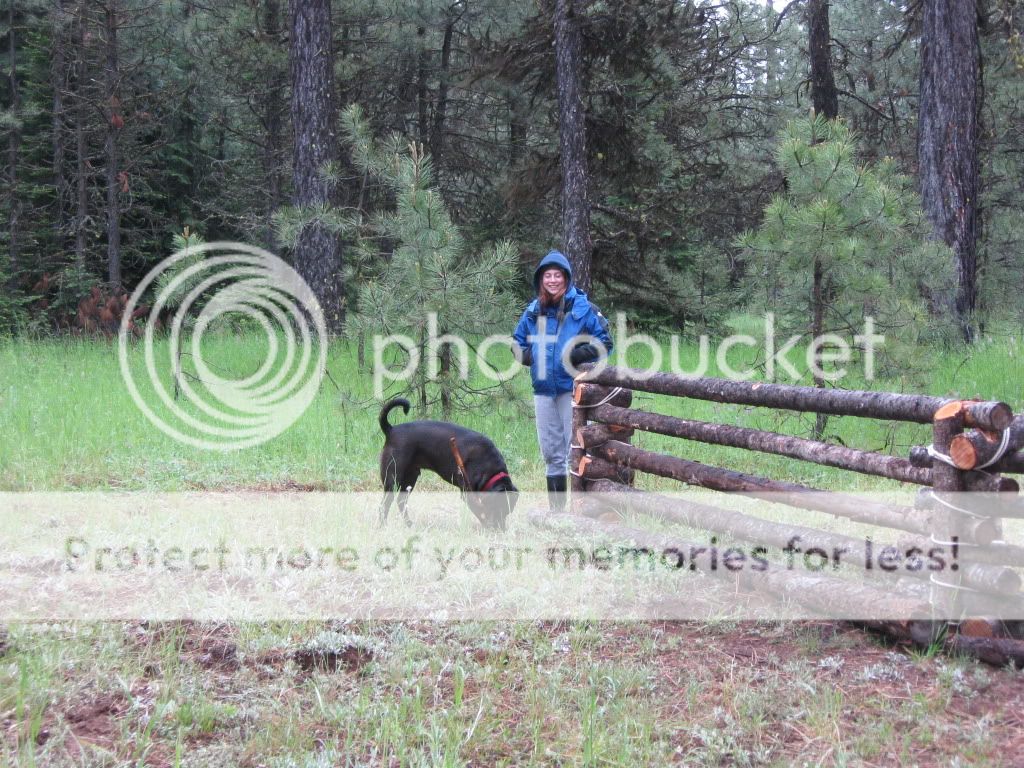
Here is the skinny-ish fence, AKA "linkin log fence," with me and the (big) dog for scale.

Dressage was so-so. It was still absolutely freezing outside. On XC, at least you're moving around a lot - out there, we stood still for most of it, because we were doing individual work on riding our tests. I don't really have a lot to say for it, I guess. Pandora was so-so, we worked for only ten minutes or so, and the instructor focused on riding the test, not riding the horse. It was a very very good thing for me to learn, because nobody's spent much time on test-riding strategy with me before, but not too conclusive for training. Still, she was well behaved.

I actually put her heavy blanket on her for the night, and as I slept curled up in my sleeping bag, wearing sweatpants and a sweatshirt, underneath a horse cooler and down blanket, and was still cold, I was very glad I'd put it on her.

I'd finally decided to run Novice at the derby the last morning. I figured, our dressage is going to suck because of her tension either way, and not a huge difference in the tests if you're only schooling. And what better place to test out the gears of a higher level than a low-key camp where you can take time to school or drop down if things don't go well? All evening, though, I struggled with whether or not to scratch. The constant drizzle hadn't let up. I was tense, the way your muscles never seem to fully relax when you're cold and tired and slightly miserable. Pandora was tense, probably also from the cold but a lot just from being there. To be perfectly honest, I'd have traded the derby to be home and dry!


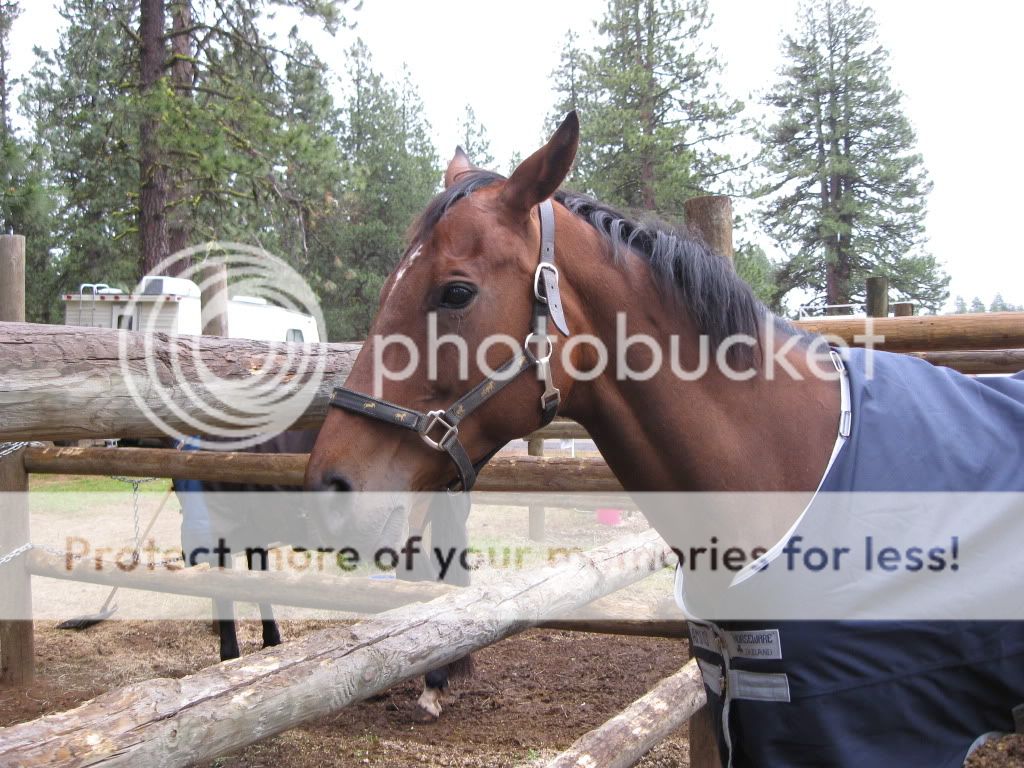
Cold, wet, and grumpy! (Maybe she's grumpy because I don't have her halter adjusted right)


By the next morning, Sunday, I was fully decided to scratch. Not only were we both pretty tired and a little stressed, a mass of fog rolled in and the rain still hadn't stopped. The footing out on the course was good when dry, but the mud turned hard and slick when wet. To me, it just wasn't worth risking our newfound confidence, and I knew she'd want to go fast.

Turned out it didn't matter - they canceled the derby for all the reasons I mentioned. I was glad I'd made the right decision anyway, and I certainly wasn't heartbroken that it meant I got to pack up and head home earlier than I'd expected. My parents came to pick us up, so I was a little disappointed that they didn't get to watch me ride, but they've seen me before and they'll see me again. I'm probably anthropomorphizing, but Pandora sure seemed glad to get on the trailer later that morning.

Before we left, my buddy and I took my parents and my dog on a course walk. It is quite the hike, but it was worth it. The dog had the time of his life. I don't know if I've mentioned him before, but Kuma is a 2 year old Rottweiler/Chocolate Lab mix we got from the humane society last year, and he is a big 100-pound ball of affection and energy. He ran all over the place, fell in the creek, chased sticks and his ball through grass twice as tall as him, and in general had an awesome time. He bounds like a deer when he runs through the tall grass, so cute. Someday I'll post the video I have of me and him playing fetch with a blade of grass - yes, he's that focused on playing fetch.

So, after that we loaded everything up and headed home. It got warmer as we went, which was nice - I'd been wearing a tank top, t-shirt, long-sleeved riding shirt, turtleneck sweater, crew-neck sweatshirt, hooded sweatshirt, AND rain jacket. Might have been a little overkill, but I hate being cold. That's why I'm so puffy in the blue rainjacket picture!

McKinna hollered awfully loud when she saw Pandora, poor thing. I think she thought we took her away forever! Anyway, they had their joyful reunion, Pandora got several days of well-deserved rest, and then you know what has happened with the injury and lameness nonsense.


So, Lily Glen was a really good experience. I'm pondering whether to go back next year - it is a long drive, and horse camping is plain exhausting, especially when no parents are there to help out! I had some really good lessons, but I also had some that weren't all that useful. The first two horse-management lessons taught things that I already knew, though the third was very interesting. It was cold, and tends to be cold on a regular basis.

On the other hand, I did have a good time. I enjoy any opportunity to really get to know kids from other Pony Clubs, since we don't get the chance all that often. The course is beautiful, and I would love to ride it as they continue to make progress rebuilding. (I've heard they're looking for old course maps to help rebuild the course, so on the off chance that any of you rode there in the past, let me know!) It's also only $200 for many days of lessons and activities and food, though you do have to factor in gas and travel time.

Anyway, it's not something I'm decided about now, and who knows what my summer plans next year will be. Overall I had a very good time, learned a lot, and I'm glad I went.

Friday, June 26, 2009

Lily Glen: Days 1 - 2

By Tuesday night, everything was loaded in the trailer tack room. As in, we fit all the equipment for five days of horse camping for two girls and two horses, including three MONSTROUS bales of hay plus one smaller one, inside a normal trailer-sized tack room. It was a triumph of engineering, let me tell you.

Anyway, after a fairly long and uneventful drive, we pulled into the campground. Lily Glen is an absolutely beautiful place.


It's kind of a sad story, actually. Lily Glen is actually public land, donated awhile ago by someone. From what I understand, Lily Glen used to be the premier recognized event in Oregon - for a time, the ONLY recognized event. The course went up to Intermediate. A few years of terrible flooding essentially ruined it, destroyed the footing and the courses. A big old barn, kind of a landmark, burned down - lots of people donated their time and money to rebuild and restore it, and the new one burned down too.

Noble Riders Pony Club is working very hard to build up the course again. They've added several new cross-country fences each year, and right now the course goes up to Novice. I hope someday it can be a recognized event again, but we'll see. It's so sad to walk by the broken-down ruins of these old, huge fences, big hanging logs, skinnies, water complexes.

But, I was there to ride and have fun at camp.

Over the course of the whole week, Pandora was just not very settled. Don't think she was a big fan of the whole openness. She didn't eat her grain very well, though she ate probably 80% of it, and didn't plow through hay like she normally does. On the other hand, she drank lots of water and didn't seem unhappy, just a bit on the tense side.

We of course breezed through the jogout on Wednesday night. Pandora was a bit nervous because of all the stuff going on, and I swear she grows about a hand when she's a tad spooky - she puffs up and it's very pretty to watch, though a little disconcerting to try to steer. Anyway, I got a compliment from the judge/inspector about my "lovely mare." Why yes, she is quite lovely!

First lesson on Thursday morning was XC. Pandora was hot to trot and OMG she looked adorable in her brand new red fly bonnet. I hope someone got pictures. It wasn't even a silly purchase, because she inherited typical sensitive TB skin and absolutely hates flies. Anyway.

Our warmup was just perfect for her. The whole group rode on a big circle, walking awhile, trotting for five minutes or so, then a little cantering. I'm learning that she just wants to get out there and move when we're in jumping mode, no stupid standing around or quiet walking or expecting her to trot slowly right off the bat. She just wants to get a forward, no-nonsense trot going, then I can start asking her to adjust or transition.

She jumped marvelously that day. She is developing a rather forward-but-not-rushing attitude to the fences, which I really enjoy. It's a blast to ride and she was jumping like a rockstar. The only times we get into trouble are when I think the instructors want something slower, so I pick, and she either fusses or chips the fence or both, so I just need to stop second-guessing and always ride nicely forward.

The instructor had a really nice tip, too, for horses who warm up pretty tense and stiff at the walk. She said to just put toe pressure on each stirrup, like you're pushing down a brake pedal, as each shoulder comes forward. Left, right, left, right. I'm not sure how exactly it works - I'm guessing the way it sort of imposes a gentle rocking on the horse's back - but it really seems to help them slow, relax, and stretch down, at least a little bit. I tried it a little at the trot and met with some moderate success there, too.

Our second lesson of the day was pacing. I expected, I don't know, marked-off sections of 100m each and tips on how to get and maintain your ideal pace, but we ended up going on a strange little trail ride for about 40 minutes, then she took us to a big loop and essentially told us how long it should take us to complete it at a certain speed. So, not particularly useful I guess, especially since I got lost the first time. The second time I wanted to aim for 350 meters per minute, a solid BN pace, so I asked and she said it should take 3:50. I held a steady canter through the woods, had to drop back to a trot for some tight switchbacks, and had to really hold her back on the open stretch at the end because she just wanted to FLY through it.

I still came in closer to 400mpm.

So, well, I know the dang horse can go fast. But I'll have to be careful not to gather speed faults on my BN courses, though I'm planning to ride Novice at the rec. HT next year if all goes well.

And thus concluded the first night.

My buddy and I went for a bareback hack, which was fun - we played in the water crossing, which Pandora was not a huge fan of (she hates deep mud, can't say I blame her) and cantered around a little. I almost fell off, because her canter got really bouncy at one point on a turn, but I just grabbed mane and hauled myself back on. Later in the week, we were headed down a mown path back towards camp when my buddy on her little QH mare picked up a canter. Well heaven forbid we walk when they're cantering, and trotting bareback is no fun, so I had to canter too.

Pandora has a much faster canter than my friend's mare, so we rather quickly passed them up, Pandora took a little leap over a shallow ditch, and we did a bit of an accidental bareback gallop towards camp. She pulled up pretty easily with a circle, and it was fun. Staying on is easy in a straight line!

The second day was, um, a little bit less spectacular. We started off with grids. Most of our problems, I'm pretty sure, came from a woefully not-ideal-for-Pandora warmup. The instructor had us get in a line and pick up a trot, then adjust our speed forward and back without breaking rank. Except, well, I was behind the my friend's mare - who has a nice trot and is capable of slooooowwwwwwwwwww when the instructor asks for slow - and so I had to be up in Pandora's face pretty much constantly - even in the forward trots - to keep from breaking rank or running up the pony's butt. Then she had us go straight into trotting grids.

Nope. Pandora was not having any of that. Definitely not a good warmup for her and by this point she was all wound up.

So then the instructor sets up a pole in front of a cross-rail, says we should be putting in two trot steps before the x-rail. So, because she said so, I tried to half-halt really strong to get the two steps, since I knew Pandora was really hot and would just want to leap the whole thing. Which was a bad idea, because she flipped her head and whacked me in the nose with her poll.

Which hurt, a lot.

Ugh. Basically, the rest of the lesson sucked and I had to work hard just to get her to trot calmly through some trot poles. She lost a lot of trust in me in the beginning because I fought with her so much and she had a crappy warmup, and I just couldn't get her back. Lesson learned, I guess, and I did carry away some ideas about how to control her with more seat than hand. And also the knowledge that even if I think an instructor wants a certain thing, I need to be careful not to compromise what I know simply will not work with my horse.

I was dreading our second lesson of the day, dressage. She's been a nutcase so far, so now I'm gonna ask her to be calm and quiet??

Much to my relief, and again with a much more suitable warmup, I had my horse back for this ride. She was pretty forward, but not ignoring me, and when we did some one-on-one instruction I got some reeeally nice work with a spiraling trot circle. The inside of the spiral was very difficult for her but it produced some very nice gaits, so I know that's something I need to practice.

It was a bit of an emotional roller-coaster of a day, to be honest. I am so used to everything always being calm and right with Pandora that when I have an awful lesson like our grids session, I start second-guessing practically everything. Is she right for me? Does she hate my bit? Is she feeling okay? Am I ever going to get her to relax? Is she developing bad habits that she's going to have forever? Is she getting hotter and hotter the longer I own her? And I just go round and round. I'm glad I had such a good dressage lesson about an hour later - it helped knock some sense into me and make me remember that it's not the end of the world if I have a bad ride. More on that later, I think, it's something I need to spend some time talking about.

Lots more to write about. I learned a lot and I don't think I can get it all down in just one or two posts! I keep remembering more to go back and add. Next I'll write about the last two days of camp, then talk about the horse management lessons we had while we were at camp.


PS, tomorrow I'm going to watch the upper-level XC at Inavale's recognized HT. I am SUPER excited!

Tuesday, April 21, 2009

A Constructive Mindset


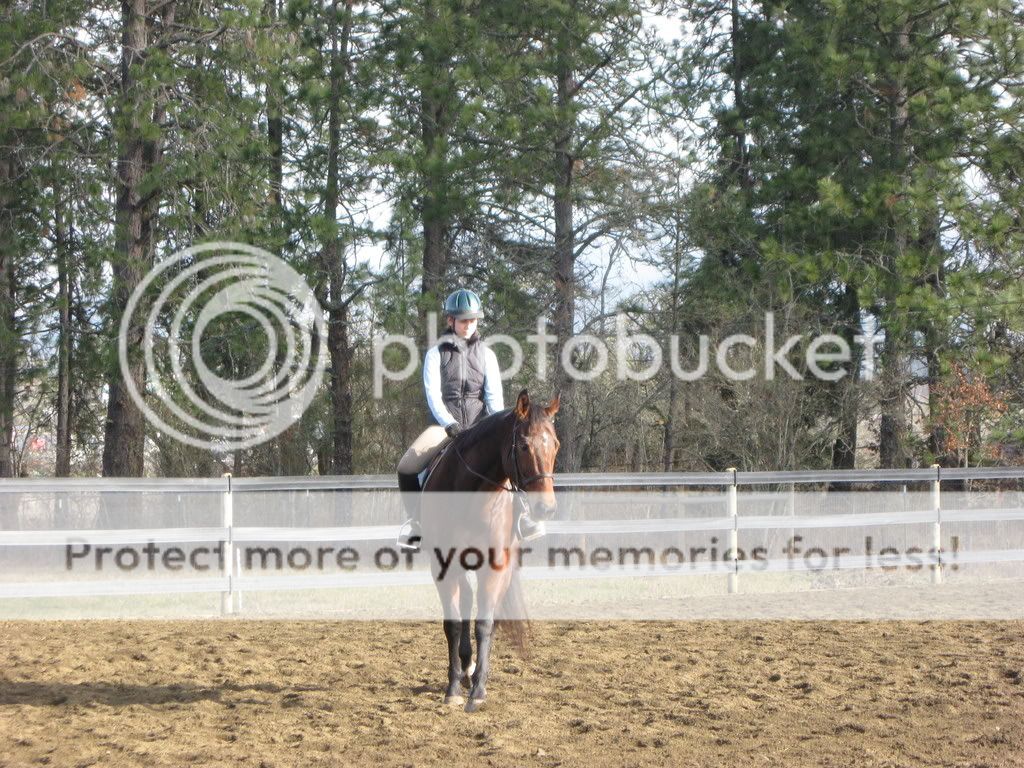
Trotting at Karen O'Neal clinic, 4/19/09


I've been thinking a little bit about what you can do when you ride with a constructive mindset.

Tuesday evening, it was raining hard. In the arena, it sounds loud, no matter how lightly the rain is falling. Pandora had some extra 'go.'

Normally my warmup is pretty relaxed. Walk a little, trot a little, bend a little. This time I decided I needed something to focus on. We started walking serpentines. On the straightaway, I insisted on, well, straightness. Even weight in both reins, even feel between the legs: straight.

It was harder than it sounds.

It felt like she was a pinball going back and forth, almost bouncing between the reins. After a few loops, she understood, and settled in nicely straight. I requested a forward, marching walk -- come on, girl, let's act like we have somewhere to be!

When we picked up the trot, she was feeling the Thoroughbred half of her breeding. That is, she was Forward. More so than she usually is, and more so than I'm usually comfortable riding. I tend to be a little bit of a control freak, because I had so little in the way of half-halts and speed control on my first horse. With Pandora, simply because I can control her momentum with half-halts, I do it too much.

But this time I decided to work with what she gave me. I took that energy and said, "Okay -- let's go." I asked for a big, powerful trot, then asked her to come back to me and compress her stride. I insisted on correct bend. I would push her forward through the corner, accelerate, then come back. We did some leg yields. When we picked up the canter to the good direction, she powered right into it. To the left was still a bit unbalanced, but I'll take what I can get.

The most important part of this was that I came into the ride with a constructive mindset. Sure, she was a little hot, and maybe she wasn't too focused when I mounted up. But I took what I had and I decided I would do something with it -- so we had a really nice ride.

It's important to me to take some benefit out of every ride, no matter how many things didn't go as planned.


I applied the same concept to a clinic I rode in this weekend.

We ended up spending two and a half hours in the saddle - probably an hour and a half in the arena, then another hour on cross country. The arena is beach sand. Lovely and soft, sure. But have you ever gone running on sand? It's hard work.

So I was already stressed about the demands on Pandora's fitness. I know, I worry too much, she's half TB anyway. But that made me a little tense to start with.

Then we rode forever and ever and ever. The clinician was great and had some really good advice, but sometimes it was unclear when we could give our horses a break and when we should keep going.

THEN we went outside. Between struggling to keep a tired Pandora up off her forehand, fighting with her about adequate brakes, and a little confusion about what exercise we were doing, I got pretty frustrated. I did keep my mouth shut and do what I was told, because the way I see it, you go to a clinic to learn, not to argue. ESPECIALLY not to complain that you're tired and so is your horse.

So I kept at it. And you know what? I got some really valuable lessons out of it. Towards the middle of the XC session, I finally understood what she was trying to get me to do with my hands and seat at the base of the fence (I was dropping Pandora, again, sigh). When I started riding right, Pandora started going very very well, as usual.

I found that, even after 2 hours of hard riding in the heat, when I was exhausted and my horse was pretty tired, I could still get around a course of obstacles without Pandora falling on her forehand -- provided I rode correctly.

That is GOOD knowledge to have. That means that when we've been riding for an hour, I know better than to think 'Oh, she's so tired, it'll be impossible to jump without falling on the forehand!'

Nuh uh. I need to start asking more of her. This is a big weakness of mine. I just don't push hard enough.


Anyway, I just wanted to get that out there. There's always a valuable lesson out there, even if you're hot and sweaty and grumpy and tired ;)

Monday, March 30, 2009

Rally Report

Wonderful was the word of the weekend, used first in bitter sarcasm to describe the wind and rain, later for the few hours of sunshine that warmed up the barns a tiny bit, frequently to note appreciation for the readily available hot cider and hot chocolate, and as the rally went on, increasingly to describe my Pandora.

Saturday evening found us arriving in light drizzle, which naturally turned into a sheer downpour as we carted in the last of several wheelbarrow-loads of equipment and tack. Horses were screaming for their lost buddies. We set up tack rooms equipped to Pony Club standards for four riders, feed rooms with labels and perfectly secured grain containers. We used plenty of sawdust to bed down stalls whose dirt floors geographically resembled a love-child of the Rockies and the Grand Canyon. Conveniently, the wind blew straight down the barn aisle. At 7:00 sharp, we had to bridle our horses and stand in line outside to jog out for soundness. Then came bit/bridle/helmet checks. Then a written test from 8:30 to 9. Barn closes - make sure you're back at 5:30 tomorrow morning to feed and be ready for the rally briefing at 6:30!

Wonderful.

I am not a morning person. I consider 8 to be the perfect wake-up time, provided I went to sleep at 10:30. I tend to need that much sleep. I can get up at 6:30 and function for the day if I need to. But 5? No.

Anyway.

Wander blearily into the barn at 5:40, throw hay and fill water. Pick stalls, sweep aisle. Rally briefing, which goes mostly in one sleep-deprived ear and out the other, though important things like 'Don't be late to anything or you lose massive amounts of points' stick. Head back to the barn, curry and brush and brush and brush and tack up for the Formal Inspection.

After Formal (with no penalties, I might add), I headed to the warmup arena promptly on time in order to stand for twenty minutes outside of it because it's small and they only allow six horses at a time. I realized ten minutes into my wait that I had somehow misplaced my medical armband with my release form in it, which is now required to be worn at all times at all rallies. Trotted a puzzled Pandora back to the barn, frantically found my Stable Manager (not the first time, and certainly not the last, that her calm smile and efficiency would be my saving grace), retrieved the missing armband, and returned to the arena to wait another five minutes.

My warmup began nervously, but settled down remarkably quickly. Pandora, bless the mare, is not a horse in need of lengthy warmup. After twenty minutes, we'd calmly taken several fences, and I'd memorized my course and double-checked this memorization at least ten times. I and the butterflies in my stomach were ready to ride.

"I'm scared, but if you say so, I'll do it," said every inch of Pandora's pricked ears and wiggly, warp-speed trot. Scoot though she may, once she was pointed at a fence, Pandora did what I asked of her -- even over the rather bright fences, between lavishly decorated standards and plenty of decorative greenery. The swedish oxer, which spooked a lot of horses, didn't phase her much. A bit rough, a bit chaotic, but we made it clean and I slowly began to understand the trust Pandora placed in me.

Untack, groom, dunk bit in water, fill water, pick stalls, sweep aisle, wipe tack, blanket on, change into warm clothes, don't forget the armband. I helped my stable manager reorganize the tack room, which after four riders' worth of Formal Inspection and ride preparation looked like a tornado zone. We watched some of my teammates ride, but all too soon it was time to tack up for round 2.

Warmup was shorter this time; Pandora was much more relaxed. We put in a reasonable round. She was calmer, I was calmer; we cantered more fences and took conservative lines because until we locked onto a fence our steering was a bit suspect, but we made it around clean again.

I took care of all business, then took a moment to breathe. I glanced at the watch hung up in our tack room for lack of a clock. Good - an hour and a half till my ride time. I had enough time to wander back to the arena and watch a little. On my way by, I happened to glance at a clock hung in the aisle way...which read an hour later than the watch in my tack room. After verifying that this was the correct time, and taking a moment to very quietly swear about the fact that I now had twenty minutes to tack up, get a safety check, and warm up, I grabbed a teammate and scooted back to the stalls.

After a grooming and tacking-up that lasted about five minutes and was undoubtedly the shortest I've ever managed, I arrived at the arena two minutes before my ride time, just in time to wait for another ten minutes because things were running behind.

Wonderful.

I warmed up for maybe five minutes. She just didn't need any more. She was with me, she was good. This round was "choose your own line" -- jump every fence once, in whichever way and order you please. I had planned an ambitious course, full of tight jumper turns neither of us usually do. To make sure we had it in us, I practiced tight turns to an oxer in the warmup arena. Outside rein, outside leg, push forward out of the turn to the fence. Perfect.

It was one of the most fun courses I've ever ridden. Salute. Canter, first fence, right corner, second fence, left corner, third fence. Around to the fourth, the big blue swedish oxer, then over five and a super tight turn to six that walked reasonably but was just too tight for her to make...though she sure tried. We skipped to the side of the standards. No worries, loop back to jump it, then fence seven, rollback to eight, tight turn to nine, and through the flags.

Wonderful.

I came off that course with the biggest idiot grin on my face ever. I was pumped. Never mind that one turn -- that was my lack of course-walking experience combined with Pandora's much-appreciated sense of self-preservation, not her fault -- she was awesome for me. She sat up, did the tight turns, powered up to every fence, nailed all the striding and did all kinds of flying changes on her own.

What a horse I have, I thought as we walked back to the barn. For her to rise to my challenge and run that tight course, when we'd never practiced things like that before, was fantastic. For her to listen to me every single round, and always be there for me when I asked her to do it, was awesome. It was a really powerful experience for me. I was suddenly overwhelmed with gratitude that this gentle, sweet mare, who always closed her eyes and leaned her forehead against me when I slipped into her stall to say hello, would put so much effort forth for me -- would trust me that first round when I said "Jump, please," and she said "I'm scared, but which fence do you want me to do?" I felt somehow humbled, that I could ask her to do such a hard, twisting course, the likes of which we'd never practiced before, and she would unquestioningly do it. It doesn't sound that remarkable, writing it down. But in that moment something changed about the way I see her. I'm suddenly so grateful, so in wonder of her willingness to trust me and to try for me.

What a horse.

It was all a relatively easy downhill from there. Take care of the horse, watch my teammates ride, begin tack room tear-down, go to awards (we took fourth and fourth in horse management and overall scores), load up, finally get home and crawl into bed at midnight.

I think I was sleepwalking through most of today.

When we got out to the barn this evening, the horses were out in paddocks, cheerful and alert in the cool air. I lay with just my head under the electric fence, pulling long handfuls of grass and setting it down for the two mares, smiling at the quick thump-thump of their lips as they vacuumed it up. Everything had a yellow cast from the lazy sunset, the temperature was perfect, and all I could smell was the grass they eagerly lipped up from my hands.

Wonderful.

Friday, March 27, 2009

Quiz Study I: Diseases

We'll begin with an introduction to some common communicable diseases and vaccinations. I'm taking this from a lecture and sheet we were given about diseases at the ABC Retreat for Pony Club. The lecture was absolutely wonderful and was delivered by Dr. Liz Hoffman.

Please note: I am not a vet, and I don't play one on TV either. You need to talk to your own vet to figure out the best vaccination schedule for your own horse, etc etc etc. I am here for educational purposes only.
Also, this is definitely NOT a comprehensive list! Just the basics.

First, your vaccination program will vary by area. For example, around here, not everyone vaccinates for Rabies. According to my information, no cases of equine rabies have been reported in Oregon or Washington.

Vaccinations do not provide immediate protection. Many vaccines require a series of shots, and it takes up to 2 weeks for the immune system to begin creating antibodies.

For mosquito-borne diseases, it's best to time your vaccination just before the start of mosquito season. For us, that's usually sometime in March.

Most of this information comes from the AAEP, or American Association of Equine Practicioners guide to vaccinations.

First, the diseases for which a vaccination exists.

Tetanus
aka Lockjaw
Affects the nervous system. Caused by a bacteria that thrives in anaerobic environments, like soil. Transmitted by puncture-type wounds.
Symptoms: Tense muscles, inability to open jaw to eat properly, exposure of the 3rd eyelid. Eventually, the respiratory muscles become paralyzed, causing death.
Treatment: Antibiotics, supportive care.
Prevention: Yearly vaccination. Some vets recommend a booster vaccination if your horse sustains a puncture wound and it has been awhile since their last vaccination - check with your vet.

Encephalitis [Eastern, Western, Venezuelan]
aka Sleeping Sickness
Affects the nervous system. Caused by a virus. Carried by birds and transmitted by mosquito bites.
Symptoms: Fever and excitability which goes to depression, drowsiness, and paralysis.
Treatment: supportive care.
Prevention: In some areas [including Oregon], you don't need to vaccinate for the Venezuelan strain, but all horses should be vaccinated every 6 to 12 months.

West Nile Virus
Affects the nervous system. Caused by a virus. Carried by birds and transmitted by mosquito bites. A serious and often fatal disease.
Symptoms: Loss of coordination, abnormal gait, muscle tremors, depression, inability to get up.
Treatment: supportive care.
Prevention: Vaccination every 6 to 12 months, depending on mosquito exposure.

Rabies
Affects the nervous system. Caused by a virus. Transmitted by bites from infected animals such as bats, skunks, and raccoons.
Symptoms: Excitability, depression, inability to swallow, paralysis, death.
Treatment: None, always fatal.
Prevention: In areas where rabies is common, horses should be vaccinated yearly.

Influenza
aka Flu
Affects the respiratory system, caused by a virus. Usually affects young horses or those exposed to numerous other horses [showing, for example]. Transmitted through the air and by direct contact with mucus.
Symptoms: Similar to human flu. Fever, loss of appetite, depression, cough.
Treatment: Supportive care and antibiotics to prevent secondary bacterial infections.
Prevention: Vaccination every 6 - 12 months. [Interesting note: the Pony Club manual says every 2 - 3 months, but according to the most recent veterinary opinion this kind of frequency isn't really necessary.]

Rhinopneumonitis
aka Rhino
Affects respiratory, reproductive, and occasionally neurological systems. Caused by Equine Herpes Virus type 1. Usually affects horses under age 5 and pregnant mares. Transmitted through the air and through direct contact with mucus.
Symptoms: Similar to human flu including fever, loss of appetite, depression, and cough. Causes abortion in pregnant mares. Occasionally neurological symptoms.
Treatment: Supportive care and antibiotics to prevent secondary bacterial infections.
Prevention: 2 types of vaccine: a live virus for respiratory infections and a killed product for abortion prevention. Pregnant mares should be vaccinated at 5, 7, and 9 months of gestation with the killed product. Horses traveling or exposed to lots of other horses should be vaccinated every 6 to 12 months.

Potomac Horse Fever
This is a 'ricksettsial disease,' similar to a bacteria. It is transmitted by freshwater snails; horses contract Potomac Horse Fever by grazing on pastures that have been flooded and contain the snails.
Symptoms: Loss of appetite, fever, diarrhea, colic.
Treatment: Antibiotics and supportive care.
Prevention: Vaccination every 6 to 12 months where it is common.

Strangles
Affects the respiratory system. Caused by a bacteria, streptococcus equi. Transmitted by mucus from an infected horse and is highly contagious.
Symptoms: Fever, loss of appetite, nasal discharge, and nasty abscessed lymph nodes in the throatlatch area. Occasionally internal abscesses.
Treatment: Antibiotics, drain abscesses.
Prevention: Injectable and intranasal vaccines, given every 6 to 12 months. Intranasal is more effective, but if you use both, never introduce the intranasal material to the injection site as it causes horrible abscesses.
The AAEP only recommends vaccinating in high-risk situations; decreasing exposure and isolating infected horses works best.

Equine Viral Arteritis
Affects respiratory and reproductive systems. Caused by a herpes virus. This primarily affects breeding stock. It is transmitted through the air and in the semen of infected breeding stallions.
Symptoms: Fever, nasal discharge, swelling of the legs.
Treatment: Supportive care.
Prevention: Vaccination, testing of breeding stock, and avoidance of carrier stallions. Note that vaccinated horses will test positive, and are indistinguishable from infected horses; therefore routine vaccination is not recommended, and is often controlled by the government.
Generally not something to worry about if you're not a breeding farm.

Botulism
Affects the nervous system, caused by a toxin produced by the bacteria Clostridium Botulinum. Usually contracted by horses fed round bales of hay. It is transmitted by fermented feed or feed contaminated by animal carcasses [e.g. rodents that got caught up in the haying process and were baled in the hay].
Symptoms: Paralysis of mouth, inability to swallow, weakness; eventually the respiratory muscles become paralyzed leading to death.
Treatment: Antibiotics, supportive care.
Prevention: Yearly vaccination in areas botulism occurs in horses, especially if feeding round bales.


Now, here are some infectious diseases for which no vaccination exists.

Equine Infectious Anemia, or EIA
aka Swamp Fever
This is what your Coggins tests for. Caused by a virus; transmitted in blood from an infected horse via mosquito and fly bites or contaminated needles.
Symptoms: Fever, depression, loss of appetite, anemia, jaundice, paralysis. Incurable, often fatal. Can be acute (anemia and jaundice), chronic (lack of stamina, weight loss), or asymptomatic (appears to be totally healthy).
Treatment: none
Prevention: A positive-testing horse must be quarantined where it cannot be exposed to biting insects. Many states and shows require a negative Coggins to travel or compete. There are some exceptions, so check the state rules - for example, Oregon and Washington have an agreement that horses traveling between the two states do not need to have a test.

Pigeon Fever
The name comes from the abscesses on the chest that cause a swollen chest, not because it is transmitted by birds.
Affects the muscles and internal organs; caused by a bacteria living in soil, contracted by contact through routine abrasions. People don't get it but can carry it among horses on their clothing, boots, etc. It may be transmitted by fly bites (I believe the jury is still out on a consensus as to whether or not flies transmit this).
Symptoms: Lameness, fever, lethargy, weight loss. Usually accompanied by very deep abscesses and multiple sores along chest, midline, and groin. Can also develop internal abscesses.
Treatment: Hot packs or poultices applied to abscesses to encourage opening. Open abscesses should be drained and regularly flushed. Surgical or deep lancing may be required by a veterinarian. Antibiotics are controversial; they may prolong the disease by suppressing but not eliminating the abscesses.
Prevention: Buckets or other containers should be used to collect pus from draining abscesses [EW EW EW] and this should be disposed of properly. Consistent, careful disposal of infected bedding, hay, straw, or other material used in the stall is also important. Stalls, paddocks, all utensils and tack should be thoroughly disinfected. Pest control is also important.

Equine Protozoal Myelitis [EPM]
Affects the neurological system. Transmitted by opossum feces in a horse's feed. Has a low fatality rate, but many horses never return to full capability, and it can take years to recover.
Symptoms: Lameness, loss of balance, weakness, upward fixation of the patella.
Treatment: Marquis (ponazuril) or Navigator (nitazoxamide).
Prevention: No good vaccine currently available. Eliminate contact with opossums (because THAT's easy to do..)


So, in conclusion, some important management techniques to help prevent diseases:
Mosquito and fly control
Isolation of new horses [quarantine]
Regular vaccination schedule
Not reusing needles
Good sanitation in barn and show situations


Phew, that was a lot. Talk to your vets about this stuff. I learn new things every time I ask my vet a question, and she's always happy to explain things to me. Hope this was some good information for you guys.

PS, does anyone know what's up on encephalitis vs. encephalomyelitis? I have seen this spelled both ways and I'm not sure which is correct or if either one is acceptable.

Saturday, March 7, 2009

Quiz Rally

Quiz rally was awesome.

Let's just say it went well, as I'm sure you can tell by the picture!

I was competing on a "catch team." There are 3 - 4 competitors on a team, and our club only fielded two members in the Senior D category. So we were rounded out by two other girls from two other clubs. Unfortunately, one of the girls was sick and wasn't there - this meant that we were a "short team," meaning that unlike the teams with 4 members, our lowest score would not be dropped.

First up was the Written Test. Oh, yay - I'm good at those! There were several questions about Polocrosse, Vaulting, and Dressage (for which sport do you not use a helmet? for which sport can you not cluck to your horse? for which sport will your horse need to wear boots?). Then came questions with numbers: how many holes above the buckle on each side should a tight girth have? How many bandages required in an equine first aid kit? How many beats in the trot? How high (inches) does a D2 jump at testing? Then came different types of safety and equipment questions. I only missed two of 25 - one of which was for a question that I knew the correct answer to, but accidentally circled the wrong one!

Next was Classroom, probably the most stressful phase because everyone is watching you. All teams are in a large room and you must stand up, state your name, club, and rating level, and ask for the level of question you want. You can be quizzed at your level for 5 points, one level up for 10, or two levels up for 15. I loved this phase because I have spent a lot of time reading the manuals, and that's where most of the questions come from. I took one 10-point question and the rest 15 pointers, and I didn't miss any! I did get a bit lucky, because some of the other girls got really hard questions that I wouldn't have been able to answer.

The rest of the day was more practical knowledge testing. We had to identify various items (sweat scraper, hoof pick, leather keepers, etc) inside socks by feel. We had to identify several Rally Kit items and say which kit they went in - it sounds easy, but when you have to remember whether the rubbing alcohol or the latex gloves go in the human or equine first aid kits, it gets difficult! (It's horse and human, respectively).

One section involved rapid identification of a huge table of items - 20 items, 3 minutes to identify them. One table had tack, another equipment, another farrier/hoof care things, and the last (and hardest, in my opinion!) was a table of horse feeds. There were many different types of hay and grain feeds as well as treats and supplements.

The Barn phase was fun because it involved hands-on knowledge. One of our team members had to demonstrate the correct method of blanketing a horse, on a very large stuffed horse. We also demonstrated how to measure feed correctly and showed what items to get first if your horse is bleeding.

When the day was done, our team won 1st of 4 Senior D teams, and I got Senior D High Point. You all knew I was a nerd, right? ;-)

That being said, I've begun writing a series of posts on the things I learned while studying for quiz rally. Here's a general overview:

Diseases - Communicable and Non-Communicable
Bits, Bridles, and Martingales
Poisonous Plants

and, just for fun, Foxhunting!

PS - a girl in my Pony Club is going to ride McKinna at the show jumping rally, since her mare is working through some training issues. She rode McKinna for the first time Thursday, then took her to a jumping lesson last night. They did awesome! I love that horse - she is such a great little mare. She acted like she'd been jumping with unfamiliar riders her whole life. What a star.
I'm excited to have both of my horses at the rally! I will only be riding one, but still...it's great to see McKinna getting some jumping in.

Sunday, February 22, 2009

Insights


I love the way sometimes an insight hits you like a ton of bricks.

You've heard people talk about this thing before - maybe all the time. You had a vague sense that you were missing something, but it wasn't that big of a deal. You thought everything was going great.

Then someone says something to you that clicks into place, and WHAM!, you've got some serious new things to think about. I got one of these a few months ago. It was at the catch-riding lesson that I may have described quite awhile back. A fellow Pony Clubber rode Pandora. After we switched back, she said, "You gotta get her to stop off your seat. And get in front of the leg - but she needs to stop off your seat."

"Okay, so...how specifically do you mean stop off my seat?"

"Close your thighs and calves, sit up and stop your back, and make her stop. Just go back and forth from halt to walk. Then you can use the same thing for a half halt, just don't ask all the way."

Seriously. This was the aspect of The Almighty Half-Halt that I'd been missing. Sure, I knew it involved your legs - of course it does! You're recycling energy. Sure, I knew it was a momentary resistance through your back and arms, which your horse immediately responds to, followed by a release.

But I didn't get it.

I worked hard to get Pandora to stop off my seat. Lots of repetition: close thighs hard, hug with calves, straighten up, close hands, halt. Pause, praise, walk on. Lather, rinse, repeat.

Now I have a horse who will halt right away -- BALANCED and SQUARE -- from a walk or trot. I also have a horse who does not rush with me. She gets a little excited in the trot after a canter? I have an instant rebalancing tool at my disposal. I briefly close my thighs and hands, and she's right back with me.

I guess I did something to deserve good karma, because I got another fantastic insight from the clinic I rode in yesterday. In short, she fixed my biggest position flaw. I ride with my legs too far forward. It's always been a habit, and I've never figured out how to fix it. My other big flaw was riding with my upper body too far forward, but my last clinic helped me fix that problem. I stopped jumping ahead. But I could never figure out how to get my lower leg beneath my body without screwing up the rest of me.

This clinician had me bring my lower leg back, and I had to hold it there by really using my thighs and abs. It hurt. And oh boy am I sore today - especially those hip flexors, which really have to open up to hold that position! But I felt so much stronger and more secure. My parents weren't at the clinic, so I didn't get any video or pictures, but Pandora was really initiating forward movement and responding well. We did some low-key jumping, focusing on getting Pandora to really listen to me and make her own mistakes to figure things out.

I will definitely have to practice to maintain the position fix consistently, especially over bigger fences, but I feel like I just took a huge step forward. With this final piece of the puzzle in place, my D-3 Pony Club rating in July will be a piece of cake. She noted that this was really the last piece of the "balanced position" that Pony Club requires, so I'm starting to feel a little more optimistic about possibly rating up to C-1 in September.

From Pony Club materials: "The C-1 and C-2 is a Pony Club member learning to become an active horseman, to care independently for pony and tack and to understand the reasons for what he or she is doing. The C-1 and C-2 show development towards a secure, independent seat and increasing control and confidence in all phases of riding." The fence max at C-1 is 2'9", which doesn't sound big at all, but when you factor in the complexity of knowledge required as well as the fact that they expect your position to be totally solid almost 100% of the time, it's a little more difficult!

Anyway, I'm super excited to work on this position fix. It's the piece that's been missing! Now that I can hold a proper position, I can also work stirrupless. The way I felt before was, if I can't get my legs into the correct spot, won't riding stirrupless just reinforce the bad habits? I'm excited to strengthen my riding by working on this. I'm also thinking I should start some regular fitness, because my abs clearly need a little help!

I'm so glad I went to the clinic, even though I was sick and tired and my parents were out of town. I've kind of gotten my motivation back in the last week or so. Funny to think that so simple of a fix (read: simple does not equal easy!) can totally affect your riding.

You should tell me a story about the last time you had some serious insight whack you in the face, so I don't feel quite so silly.

Thursday, February 5, 2009

Slow Going

Hey guys - it's been a busy couple of weeks just dealing with life, hence lack of posts. But I've been riding and making some really good progress with Pandora!

I love, love, *love* how our transitions are going. We have smooth, relaxed halt-from-trot, and if at any time we get out of control or out of balance, I have instant access to a quiet transition down and back up to rebalance ourselves. Very cool.

I've got a few hours of calculus homework plus an outline for a 5-page history paper to do, so you will have to make do for now with a short post. To tide you over, here's a video of the 2'3" class from the schooling show we went to on Saturday.


She was great! Didn't even try to peek at the fences, just jumped them around as if she was saying "Finally, we get to do some slightly challenging stuff!" We did two 2'3 classes and were also entered in a 2'6 class, but by that time I'd been tacked up for several hours and I just felt like I was too tired to give her a decent ride. So, we schooled some of the 2'6 fences and she was totally fine, then we called it a day!

It was a beautiful day for the show and many people showed up - turned out to be a great fundraiser for our Pony Club.


Next week will be a little mellower in terms of workload for me, so expect some regular posts again.

Monday, January 19, 2009

Clinic Report, Part II

After a nice long break with lunch and a business meeting, it was time to tack up again.

All went smoothly. We began warming up over trot poles, which went fine after the first trip through in which Pandora tripped over every single one ;-)

We built up slowly, just doing small courses of ground rails, then small x-rails. The clinician used the best phrase I've ever heard to get me to fix my problem: "It's like the Wonder Bra - you lift and separate!"

Which is PERFECT for my problem. I tend to hunch forward; if I remember to bring my shoulders up and back, I duck forward with my whole body. If I remember to sit up, I round my back and hunch my shoulders. When I remember this visual, it does both, and it really helped me fix my position. With this and consistently remembering my elbows (just visualizing the crop behind my back does the trick!), I felt a big improvement in my ability to stay out of Pandora's way.

At the end, she just started moving the fences up. They don't look big in the video (they're awfully tall standards) but our last fence measured at around 2'9". Which isn't big, but - considering I'd been treating her as a green horse and never jumped higher than an X - was quite fun. Obviously the clinician was able to see something in her, because she just casually started bringing the fences up and told me to canter in and just jump them.

I had a BLAST.

Here's the short video. Excuse the total lack of sound - it was the easiest option.


I was positively giddy. Which is silly - I knew she could jump. Her previous owner (not the one I bought her from) was jumping her at Novice height before the meltdown. I guess I just didn't think that she'd feel athletic. Over that last fence, she really rounded her back, sucked her knees up high, and gave me a real jump. Her ears perked up, her stride opened up, and I could just feel her going "FINALLY, we jump something real!"

In light of this, I think I am shifting my plans with her to cover a longer period of time. I am starting to believe that she's more suitable for me than I originally thought. My mom suggests that I plan to keep her for at least a year, and I think that's reasonable. We're improving fast now that I'm taking her to all of the Pony Club lessons and clinics - and competition season is starting up, so I'll hopefully be going to the Show Jumping Rally, the Dressage Rally, and the Eventing Rally. There's also an Eventing Camp the week before the Inavale HT, which would be awesome. By the time we hit July, Pandora and I will have put in a lot of miles together!

I'm not relaxing my training schedule, though. I know that if I'm not paying attention, June will pop up before I even realize it, and I'll be unprepared for the Horse Trials. But, I am relaxing a little and taking a view of her more as My Horse.

I know most of you probably thought this would happen anyway! I think I was so caught on the idea of her being a project horse that I just didn't stop and think about the possibility of her being a great horse for me, you know? So we'll see where things take us. Nothing is set in stone, but after that clinic, I'm excited to see where we end up.


PS: I learned so much at the ABC retreat this weekend. I will write up a full report ASAP, or by the end of the week, whichever ends up fitting into my schedule better ;)

Sunday, January 11, 2009

Clinic Report, Part I

I took Pandora to a Pony Club clinic yesterday. I had a fantastic time and made some excellent progress with Pandora. To give you an idea of how happy I was at the end of the day (while Pandora was less than impressed with how much work she'd had to do), here is a visual aid:


Here's the way the day went (and it was a long day: thus, a long post).

Two riders in each session. One flatwork session before lunch, one over-fences session after lunch. About an hour for each ride. More than Pandora's used to in one day, but with a long several-hour break for hay, water, and relaxing in between, she was fine.

First off - I really, really liked the clinician. She clicked with me, and from what I could tell, a lot of other riders too. She listened to what I told her about what I was working on, combined it with what she saw, and put us to doing exercises that would help.

Key: she fixed me before she expected me to fix my horse.

She was big into body awareness, and she helped me fix the consistent problems I have - without me having to tell her what they are. I tend to lean forward, especially over fences; when I try to keep my chest up, I round my shoulders and roach my back, but when I try to keep my back flat, I duck my whole upper body down. I also ride without enough bend in my elbows. She fixed all of this at once by using one of those time-honored pony club 'punishments': the good old crop-behind-the-back exercise.

We didn't get any good pictures, but basically the crop goes between your back and your elbows. Your arms are thus pulled quite a ways back, forcing a bend in your elbows (and making me grateful I had long reins, cause damn, it was hard to reach the reins from there!). It's pretty easy to remember to sit up when you're contorted like that.

It didn't hurt, but it sure made me aware of how much I tend to slouch forward when I ride. Here's a picture of the middle of the crop-riding process (notice she also had us riding without stirrups - the horror!):


You can see in this picture that I'm still a little forward and rounded with my shoulders. It doesn't feel like it looks, and that's the problem: when I was riding like this, it sure felt like I had my shoulders opened and back. Not until I increased the motion until it felt ridiculous did she tell me that I was, in fact, correct. This is why eyes on the ground are important.

She later used the single best mental image I've ever heard to help me fix the derivatives of this problem over fences. Gotta save it for later, though.

Throughout all of this, we stayed on a large circle doing lots and lots of transitions while working on our body position. And you know what? When I sit up and keep my leg on, Pandora's transitions get a lot better. She leans on her forehand. A lot. So this is important, because her transitions usually involve diving to the forehand, not pushing with her hind end. The instructor used "forward into the walk" (from a trot) to help us retain the feeling of forward movement even in a downward transition.

Very cool. By the end, I was getting much better trot-canter transitions than usual, and our walk/trot and trot/walk transitions were just awesome.

Oh, and she also had us do the "bicycle exercise" to get the feel of the sitting trot, which I won't explain to you until I can show you. I never thought a riding exercise could take more careful balance and coordination than the sitting trot...but boy, was I wrong. I was laughing so hard (at myself) during this exercise that I could hardly breathe. I felt absolutely ridiculous. Unfortunately none of it was captured on video, but I promise that the next time I ride, I'll have my mom film some trot-bicycle-exercise for your enjoyment.


Then, break for lunch and other lessons and so on. Pandora got to hang out in a nice comfortable stall with plenty of hay and water.

She looked pretty sleepy.


Then it was time to tack up for round 2. She was not particularly enthusiastic about being tacked up again ;-) But she tolerates me and my Unreasonable Demands.

I'd like to get this up tonight, but I just don't have time to go over the second half of the day - so you can have this part now, and I'll post the second bit (including video of our awesome last fences) in a day or two!

Sunday, January 4, 2009

Knowledge Gaps

Our Pony Club is getting ready to do Quiz Rally, which is exactly what it sounds like: a competition based on horse knowledge. There's several sections, many based on oral answers but also on practical demonstration, object identification/comparison, and a group section where everyone can confer to come up with an answer.

We had our first meeting today to do a quick rundown of subjects and figure out what areas we need to cover. Everyone ended up with several topics to study, which we'll then present to the rest of the group. I tried to steer towards areas that interest me, so here's mine.

  • Rally rules for Eventing and Polocrosse (equipment, fence heights, elimination rules, team sizes, etc)
  • Communicable diseases (symptoms, ways of transmission, long-term effects)
  • Bits/misc tack (effect, fit, what is allowed at what level of Pony Club)
We went through some sample questions, and I was surprised at how many gaps there are in my knowledge. I know almost nothing about diseases, for example. I know Rhino is an important vaccine for pregnant mares; I know Strangles is nasty and very contagious, but rarely fatal; I know EEE and WEE (eastern/western equine encephalitis) have neurological symptoms....but I really don't know the specifics of each, like how to recognize and treat them or their vectors.

I know the different cheekpieces and mouthpieces of snaffle bits, but I don't know how to properly attach a pelham.

I know next to nothing about poisonous plants.

I can recognize bad leg conformation, but I have trouble giving specifics, like differentiating over at the knee and back at the knee.

I know what the farrier tools are and generally what order they're used in, but I didn't know how to describe a pair of pincers.

I'm still confused about laminitis and founder, though I know the basics.

And I sure as heck don't know much about foxhunting! Some of the sample questions included definitions for "brush," "covert," "view-halloo," and "whippers-in." (Those would be "the tail of the fox," "a place where the fox resides such as forest or brush," "a call made to alert the hunt that the fox has been sighted," and "staff members of the hunt who assist the huntsman in managing the hounds.")

So I'm actually really looking forward to the weekly study sessions we have planned for Quiz Rally. There's some things I need to learn!


As far as I can tell, most people have these knowledge gaps: areas of horse knowledge that you know you should know, but somehow or another you just don't. Sometimes it's things that don't matter so much, like which order a farrier's tools are used in. Sometimes it's things that you really should know, like local poisonous plants and how to identify them.

I'm finding that Pony Club is a good resource for all these little holes, because you're forced to acquire that knowledge in order to rate up -- not to mention everyone is willing to teach you what you need to know.

Do you guys have the same sort of thing I do, areas that you just don't know enough about? Could you be put in a situation tomorrow where that knowledge could make a difference? And where's your nearest horse encyclopedia? ;-)

Friday, August 22, 2008

Camp

Well, I had a lot of fun at camp. Once again, I was very frustrated at my inability to ride (sitting through two 1+ hour lessons a day for two days makes for a lot of ideas with nowhere to go!), but I had a wonderful time getting to know the other girls in Pony Club. I enjoyed watching them work with their horses, too. We slept in the loft of the barn, so getting up and down those steps every day was interesting. I also liked watching National Velvet and reading ghost stories around the campfire :) Then, this morning, everyone played some mounted games involving relay races and water balloons.

So we're off to look at this Appendix mare tomorrow, as the woman selling her emailed Mom back a few days ago. I'll tell you the full story about her after we're a little more decided on whether or not to get her! I know that if we do get her, it will be very hard work for me -- working enough hours to pay for her board/farrier/feed/whatever, as well as riding her frequently. It will certainly be a challenge to do all that in addition to doing well in school, but I'm pretty sure I can do it. Having two horses makes it possible for me to ride with my mom as well, which would theoretically make both of us more likely to ride.

I am also the kind of person that likes working towards something. With a project horse, it's very definable: I want said horse to be calm and respectful, to jump around a 3' course, to run XC reliably, to put together a solid dressage test, so that I can sell it sometime over the summer. Along the way, I get to learn a lot about training. With McKinna, I want to rate up in Pony Club, but more immediately, I want to fix my position; that's also very definable. It means lots of longe work, lots of no-stirrups work, and lots of cantering so we can fix the damned gait.


So -- I'm pretty tired from camp (9 girls mostly under the age of 14 at a camp, hmm), so I'm not feeling up to a real post today. I'm sure tomorrow I'll talk about my impression of the mare we're going to look at.

I'm off for a nap.

Saturday, August 16, 2008

Broken-Ankle Observations

Since I broke my ankle, I've been watching a lot. I watched several lessons at the Inavale camp, of course. There is also a series of clinics this weekend, given by the same trainer, that my mom and I have been going to watch.

It's at several different barns -- the nice part is that, between the people we already knew and the people we met at eventing camp, it seems that all of the people we know go to these. A lot of them are involved in Pony Club (which is why I've seen them around at clinics, which are usually hosted by PC), and the adults either have kids in PC or ride in the clinics and allow their property to be used.

Basically, I'm with the "in" crowd now. I really can't wait to start riding -- right across the street is a giant field with beautiful XC fences as well as some really nice stadium ones, perfect for practicing our gallop and jumping fences in the open -- and another person just down the road has a nice outdoor, too.

Okay, I know I've raved plenty about all my new friends. But anyway, my original subject was the clinics this weekend. Today was really cool to watch! She started with stadium fences (in a field still), then moved them on to XC. The girls I watched ride Training, so it was really wicked cool to see them really move their horses into a gallop and jump the bigger fences.


It's hard for me to watch. On one hand, it's very very good for me to watch riders who are better than me, as well as to see what the clinician's having them do. On the other hand, it's really tough, because I get so inspired (isn't that what watching better riders is supposed to do?), and full of ideas, and I get very frustrated that I can't ride. It's like waiting for a broken heart to heal, or something equally cliche -- I know it just takes time, but I want it to be over now. Sigh.

Oh, and I think I'm going to join Pony Club. Most everything is voluntary, though I'm sure I won't be able to help myself from rating up, because I am an inherently competitive person. The way I see it is, I go to so many PC-sponsored clinics anyway, I might as well join PC and get the lower rate. Further, I don't really have any riding buddies my own age, and I'd get that if I joined. I think overall it's just a really good thing for me to have. Going to the rallies would be really fun, too.


PS, I am reconsidering the project horse thing. Do I really need to add on the commitment of a second horse, as well as the commitment to work enough hours to support it, all while just starting college? I mean goodness, if I put that much daily riding time into McKinna, we'd progress really fast.

So it's something I'm going to think about. Perhaps, if it's going well, I'll start considering a project horse late winter/early spring, so I can spend the summer with it. But for now, I do somewhat need to give myself a reality check and realize that I have an amazing horse in my hands right now, and if I put as much time into her as I'm thinking I would for a project horse, I know we could start improving really quickly.

There's your post for the day. Tomorrow -- leaving your emotions at the door.
Related Posts with Thumbnails