Showing posts with label Clinics. Show all posts

Sunday, September 27, 2009

Brian Sabo Clinic Report - Sunday

Much like the previous day, my Sunday wake-up time was a cheerful 6:00. I'd resigned myself to this fact, though, and got up without grumbling too much about internal clocks. I wandered over to say hi to Pandora, toss her some more hay, and refill her water buckets.

I must note that I didn't have to muck her stall all weekend - I guess the stabling fee covered mucking. Score.

We rolled out at about 9:00, much earlier than yesterday, but we wanted to watch everyone else's XC rounds.

Several times over the course of the weekend, if someone was having trouble with leads, Brian said this: "A flying change or a change through the trot does not school them to land on the correct lead, because it's not much more difficult to do. To school for the correct lead, you must bring them to a walk on a straight line, get your correct bend then pick up the canter from the walk." Alternatively, you could walk-halt-reinback-walk-canter, or walk, pirouette away from the inside leg of your desired lead, and then canter. Works remarkably well, from what I saw.

Another common theme was to concentrate on keeping the hind legs moving, not telling the horse to jump. "If you keep the hind legs moving, the horse will figure out when to jump. But if you're telling the horse 'JUMP' whenever you want him to take off, then you can never ever be wrong, because you're not allowing him to learn to figure it out for himself." As long as the hind legs keep pushing, you'll get over the fence eventually.

For this same reason, he prefers several clucks or kisses (to encourage continued forward motion) rather than one big cluck or kiss, or worse yet, a 'HUP!' (which cues the jump). In fact, HUP! is apparently an acronym of a french word that means "I'm a freaking idiot who can't ride."

Did I mention he has a sense of humor? ;-)

While watching the Training-level group, I heard a lot about the 95% rule: if you're jumping a post-and-rail fence followed by a ditch, water, wall, or bank, 95% of the time the horse will come in close to the fence. This affected how you should ride, i.e., don't push your horse for the long spot.

Brian consistently told riders NOT to kick their horse back up into the canter if it drops into a trot on the approach. The legs should say 'keep going,' but you don't want to transition upward. It's part of the whole "maintain" section of the approach that he spoke about before and I explained yesterday. If you keep the trot, you can encourage the hind legs to keep moving in a nice carrying gait - but if you kick them into a canter for the last few strides, they'll be taking long, forehandy strides and it's not a good way to jump a fence.

He also said that he will not move a horse from Training to Prelim until it can canter down a line to a 3'3 square oxer, transition to a trot three strides away, and maintain a perfectly balanced steady trot to and over the fence.

Every time a horse rubbed the fence in front, Brian noted that 85% of front rubs are the rider's fault. (Sometimes I think he made up percentages!) They're caused by riders leaning forward and weighting the front end, thus preventing him from getting his forelegs up in time.


Okay. As for my lesson - it was very good!

From the moment I mounted up, I could tell Pandora had remembered the lessons from the day before. Her canter had a hint of "I want to run away," but not nearly as much as before, and my half-halt was still there. We cantered a big loop around the stadium field, practicing our extension and compression, and she was right there with me. I also worked a bit on my walk-canters on a small circle. It's very hard to get the lightness, but she was trying for me.

Brian began by setting us on a very large circle around the field. First at the trot, then at the canter, he had us practice lengthening and shortening the stride. One lady had been sitting deep in her saddle when trying to compress the canter; he brought us all in to explain why this is a bad idea.

To collect the stride, you need to soften. When jockeys want to slow down at the end of the race, they stand straight up - in other words, a very nearly dressage position, legs straight beneath the body. Sitting deep like that is driving them forward, not lightening.

He then sent us at a small coop for our first fence. He noted that because we weren't practicing over something simple like a cross-rail, this first fence was going to bring out every horse's nature. The carriers would likely drop to a trot, and Pandora would probably want to rush.

Everyone had trouble. Pandora ducked out twice. The first time, I used my crop on the shoulder she ducked out on. Brian promptly informed me that the refusal was my fault for tipping forward, not Pandora's, and he wouldn't let me go on until I used the crop on myself instead!

So, with a few hard taps on my thigh, we came around to try again. I focused very hard on maintaining a tight core, looking up, and keeping my shoulders back. But she ducked out again. It sure didn't seem like it was all my fault - I didn't tip until she pulled me to the side - but I suppose if I would have ridden it perfectly solidly, she wouldn't have been able to duck.

The last time, I rode as firm and strong in my position as I could, and she jumped over it just fine.

We moved on to jumping the "pimple hill" - a little hill with a log at the top. He had us jump a cross-rail about a stride away from the base of the hill, then head up the hill and over. Here, he very strongly emphasized the importance of a solid position. He didn't want us to tip forward at all over the top. As long as we maintained a steady position with supporting leg and did not lean forward, everything would work itself out.

Wonder of wonders, he was right!

It's hard, though. The first time, I concentrated on almost nothing but being strong in my core and keeping my shoulders back.

I still got pulled forward.

After that I must have been extra-sure not to lean, because I didn't end up tipping anymore. I think, to be fair, it's a combination of me and my horse. She tends to pull me forward, even when I am trying my hardest to stay up. That doesn't mean I'm allowed to tip forward - obviously I need to work on it until I never tip. And I will, because it really did make for better fences.

Anyway, she jumped the pimple hill very nicely.

We went on to work on some water stuff and simple logs. We jumped up and down a bank into water, a first for us, but Pandora did it all smooth as butter. Again and again, I found that if I tipped forward, we got a slightly weird jump; if I didn't tip, everything tended to work itself out.

I had started the weekend wanting to jump 'up,' as in more max-sized Novice fences, because I'm tired of jumping tiny stuff. I didn't get that desire at all - most of what we jumped was simple and probably in the 2'3 - 2'9 range, but I realized that it wasn't a big deal. Brian spoke to us a little at the very end, and essentially voiced the same thoughts I was having: "I know some of you wanted to jump big and complicated stuff, and so you might be feeling like you didn't quite get to do what you wanted this weekend. But I promise you that if you take the techniques and things I taught you here and you work on them and apply them to all your riding, it WILL be worth it."

Which is essentially what I came away thinking. No, I didn't get to challenge myself and my horse by jumping big stuff, or trying a big drop into water, or practicing ditches. But I learned how to ride every fence well and was shown again and again how much of a difference it made; I learned how to ride an approach to fences that helps me teach not only come to it in a good stride, but teach my horse how to figure things out; I learned how to school my problems and turn them into strengths.

I would ride with Brian Sabo again in a heartbeat. In fact, I tried to talk him into taking me on as a short-term working student (I was thinking next summer), but unfortunately he doesn't have a permanent barn location - he travels giving clinics. Bummer. Apparently I was about 20 years too late, because once he had a great working student program! Ah, well.

He has a fantastic sense of humor and is extremely educational. He's blunt about it when you screw up, but he's just as quick to praise you when you get something right. He (probably correctly) blames the rider for most of the problems, but if a horse is really acting stupid despite a good ride, he recognizes it immediately.

Overall it was a wonderful weekend, and we told the organizer to give us a call if she has him back again!

I'll make one last post about this with some of my favorite quotes from the clinic.

And, I'm not sure if I mentioned - a friend of the friend I went with brought her video camera and taped our rides. As in, all of them, plus clinician comments, plus interesting moments from other people's rides. I should be getting the video sometime soon, and I am SO excited for it. Of course I will write about all the new insights I get from it!

Friday, September 25, 2009

Brian Sabo Clinic Report - Friday and Saturday

Our trip up to Sisters on Friday afternoon was uneventful. The horses would stay at a barn here, and each day we would haul about 30 minutes to the clinic site, which was over in Redmond.

Stabling was very nice - covered outdoor stalls that open out to big circular runs, maybe 24x24 if they were squares. The footing was sand. Both horses settled in nicely - Pandora looked around for maybe 10 seconds, then promptly drank about half a bucket of water and shoved her face in her hay.

Have I mentioned how much I love her eating and drinking habits? Always steady, always prodigious. I never have to worry about her getting enough water.

We watched Brian giving some dressage lessons. Unfortunately, with intermittent chatting amongst the viewers and the occasional interruption from a phone call or something, it was a bit hard to get the gist of what he was saying. He had a girl working on walk-canters with her Training-level gelding - that's eventing Training, not dressage Training - to help him carry himself more lightly. My glorious moment of the day was to stand in as a traffic cone in one of her corners so she would either quit cutting the corner or run me over. Thankfully, she chose the former.

We got to go check out the clinic site that evening, because Brian needed to watch a local instructor teach for part of maintaining her ICP certification. It was fun. I was a little disappointed because I'd wanted to take the horses for a hack that evening to make up for them standing in a trailer all day, but oh well. At least they had runs to walk around in, and when we returned Pandora sure seemed cheerful.

I tried to sleep in Saturday, I really did. Except, we went to bed at about 9:00, so I ended up waking up against my will at about 6. Sigh.

We got ready slowly, fed the horses, ate some breakfast, then headed over to the clinic.

Pandora was, um, "exuberant." Which in a way is good - she was channeling exactly the kind of attitude that had caused such a terrible jumping lesson about a month ago, which meant I could learn how to fix it. It wasn't quite that she was trying to bolt when we trotted or cantered . . . just that she wanted to go fast, and she really didn't want to listen to my suggestions. Not panicked or rebellious, but anxious - it wasn't a "screw you" sort of attitude, not that I could tell anyway.

The facility was beautiful, by the way. A quite long, wide field with very thoughtfully maintained and constructed XC fences, a dressage arena, and a big wide open grassy area at the very end where the stadium fences were set up.

We all introduced ourselves to the clinician and began by trotting a big circle. On the far side of the circle was four trot poles to a cross-rail. Upon landing, Pandora wanted to scoot. Not majorly, but obviously enough that Brian had a pretty quick idea of what she was like.

The second time I went through, he explained something that - as far as I can tell - effectively showed me how to eliminate her rushing on the landing side of fences. Or at least school it.

"You don't want to tell them that you're afraid of going fast," he said. "You never want to say 'NO' to that, because at some point, you do want them to gallop. What you want to say is, 'Yes I like that, but not right now.'"

So he had me go ahead and bring her back to a good working canter after the fence. THEN I asked her to open up her stride. Then I asked her to come back. Then we extended and compressed again. (He also told everyone to pay attention, because "Sooner or later every horse is going to try this and think this is a good answer, even the ones that want to go slow now.")

I swear I had a totally different horse after that. It was as if whatever anxiety had been causing the rushing just went away. "Okay, boss, you got it." A nice feeling, let me tell you. I mean, she still wanted to "push" at the fences, especially the last few strides, but everything between the fences was much more in-tune.

Also, as we jumped a fence from the trot, turned, transitioned back down to trot, and jumped another fence, he made the very dry observation that when I had a perfectly steady solid leg, a soft following hand, a still upper body and a perfect eye (not for striding, but focused forward and up), she jumped without rushing.

Gee, so if I can just be perfect all the time...


Brian characterized horses two ways: pushers and carriers. Pandora was the only pusher in our group - that is, she has a tendency to want to lengthen and flatten her stride, pushing herself at the fence. A carrier, by contrast, tends to want to shorten and slow the stride, often manifested in a transition to the trot in the last few strides of the fence. A horse's tendency will come out much more strongly when he or she is given something new or challenging, and their tendencies can change over time. Neither is inherently good or bad - you just have to be aware of it, and develop their ability at the opposite end of the spectrum so they're more balanced.

So for Pandora, she needs to be more willing to sit back and flex more in the joints of her hind end. At one point, he had me doing walk-canter-walk-canter transitions on a pretty small circle, and I was amazed at how light she could make the upward transitions. These, along with halting on the approach, turning on the forehand or reinbacking, then trotting forward, really reinstalled my half-halts. He emphasized that the purpose of the halt-correction was NOT to stop a horse from rushing, but to school the half-halt.

One of his biggest things was how you handled your approach to fences. You would come around the turn, expand the stride to generate more forward energy, then half-halt and compress to take however much of that energy you need and transform it into carrying energy. A half halt, as he defined it, takes forward and turns it into carry. How much 'carry' you need varies depending on the nature of the fence - you need more carry for a tall vertical, more push for a fence with a lot of spread like an ascending oxer.

The most important part was that after you half-halt, you must maintain exactly what you have for the last few strides before a fence. If the horse rushes, you don't fight, and you don't say "Okay you're right, let's go!" You resist with your body and hands, saying, "I disagree," but you cannot force the horse to come to the correct conclusion. Only time and a consistent experience going "Hey, I buried myself to that fence, that kind of sucked" will work.

Pandora was very good. I think I have a lot of work to do in terms of maintaining the pace those last few strides, because she wants very much to lengthen. But I have good tools, now.

It was a very long lesson, 2.5 hours in the middle of the HOT day. I definitely did not drink enough water and afterward I was a bit of a shaky grumpy mess until I drank a bunch of watered-down gatorade and ate a sandwich. After that, I was fine.

Pandora and my friend's horse got to just chill out at the trailer. As usual, Pandora drank about a bucket and a half of water, then settled down to munch on her haybag.

It was a very good day. I walked away feeling like Pandora and I were even better partners, more tuned in to each other and what we needed. Brian focused a lot on what I needed to be doing with her - expand, compress, HOLD, HOLD, and he got after me for allowing her to drop her head down after our last fence and sort of fall into a walk. Bad habit. So I started to make her still use herself, canter a circle, and transition nicely downward. She argued at first but gave in, and I admit it felt much nicer.

Only one ride, and already I had learned so much. XC would be the next day, Sunday, and I couldn't wait to see what was in store.

Sunday, September 13, 2009

Home Again!

Well, we are home from the Brian Sabo clinic!

I had an awesome time. Pandora was excellent, I am pretty sure her rushing is gone (and at the very least I have the tools to deal with it if it comes back), and we're both pretty tired but happy. It was a lot of trailer riding for her - 40 minutes to my friend's house, 2.5 hours to stabling, then each day it was a half hour to the actual clinic site.

I learned so much and I will definitely write up a full clinic report. I am SO lucky because the lady I went with (who is wonderfully fun to hang out with) called a friend, who came and videotaped our entire clinic sessions! So, if all goes well, in a week or two I should have a DVD of my whole ride, plus Brian's comments, plus interesting rides from the other people.

It was a very successful weekend. I cannot BELIEVE how much Pandora ate. She very impressively consumed almost an entire huge bale of our barn's orchard grass/timothy mix, plus a few flakes a day of the orchard grass that they feed where we were stabled. Holy cow that mare can put down the food. And water. It's hard to keep her buckets full, which I suppose is a good problem to have.

I also made my first solo trailer trip! I know, I'm 19, I should've done it long ago, but when my mom's involved with horses too, we tend to travel together. I even lined up the truck and trailer on the first try, and tonight I managed to back the trailer into our slightly difficult spot even with a car parked in the way!

Pandora, of course, informed me that she was starving and dove immediately into her big pile of hay. What a pig.

Anyway - I'm going to kick back for the rest of the evening. More tomorrow or the next day!

Sunday, June 7, 2009

A Fine And Pleasant Misery*: Part I

Hey all: I'm going to post the story from the derby in a couple parts. Last time I posted something in two parts was the Inavale camp, and the second part was the story of my broken ankle. I promise nothing bad happens in the second part of the story this time :)


Today is Friday evening, clinic day. We are camping in a tent at Inavale, and true to horse-camping form, everything has been a complete SNAFU. Except the food, but I'll get to that in a bit.


After going to my 10 - 11 Biology lecture like a good student, Mom and I had to rush around like maniacs trying to get together all the things we didn't get together earlier. The original plan was to arrive at Inavale a couple hours before my 3:00 clinic, set up the tent, unpack things, and the like. Now the plan was to actually get to Inavale with at least 10 minutes to tack up for the clinic.


We made it. Barely. I tacked up very quickly (after a momentary tangle when we accidentally switched reins onto the wrong bridle -- McKinna's bridle -- and had Pandora's lips pulled up to her ears) and headed out to the course.


Did I mention that it's been raining?


The course is wet. It is wet and squishy, and without the grace of fantastically maintained footing my horse and I would go slip-sliding away. I am in a clinic with four other people. I know one of them - good sign. Her horse is a bit wild but she's moving up to Novice and he's still looking pretty good. One going-crazy black horse with a too-tight martingale, the removal of which fixes one problem but leads to a bit of another. One slightly less-crazy black horse. One buckskin who was probably the nicest-behaved of the group. And me.


Pandora is relatively nice. I take a moment, in our long warmup, to rejoice in the fact that my horse now has a canter. Do you remember when she could barely canter? Because I can. She could barely hold it for a few strides, and even then her nose was practically on her feet if I didn't hold her up. No longer!


Jumping is reasonable. I smugly note that Pandora is the only one who will calmly trot over the placing pole and jump the little cross-rail we're using for warmup. We add a little table on a bending line. Pandora does not approve of going smoothly and calmly forth, especially when the foooting is wet and squishy and did I mention it rained earlier? Also, by now it is getting warm and muggy and even less pleasant. But I digress.


After many exhortations to KEEP YOUR SHOULDERS UP AND BACK, DON'T LET HER PULL YOU DOWN, we achieve some semblance of pretty jumping and move on to more fun things. Little courses, even.


I discover happily that if I remind myself that I do have abs, and if I pull my shoulder blades back so far they practically touch (I might exaggerate a little), I can actually keep her nose UP when we jump over ditches! And she'll actually jump over them, instead of pulling me down onto her neck and sort of oozing over! How exciting. Also, it helps if I don't look at the ditch. Eyes always up. Didn't I learn that in marching band somewhere?

Splashing through the water is plenty fun. She's quite willing, though she really prefers that we have a bit of momentum coming in. Canter up and through? No problem. Walking is a little more iffy but she'll do it if I insist.


We have a moment at the end of the XC course where we jump a bending line of two stadium verticals. Pandora is not pleased with the idea of going slow (my God, you idiot rider, we're on cross country, what the hell do you want me to slow down for??) and charges through, though she does politely leave the rails up. The instructor has me school her for a moment. Trot-halt. Walk, trot, halt. Trot, canter, halt, reinback. This makes Pandora more amenable to behaving, though I worry a bit about teaching her to back right after I halt. Bad habit in dressage. [I did test this on Saturday and have not installed a bad habit. Whew.]


So, tired and sweaty and mildly pleased with the whole experience, we head back.


NOW we get to set up the tent. And the canopy. And unload all our stuff. And set up the horse's corral. And feed the horse. And cook dinner. And go to the course walk at 7...and it is very wet. Also, the grass in the big field we are camping in in is about knee-height. Argh.


So we set up the corral, and set up the tent, and unload a little, and then it's time to go walk the course. Only to find - hooray - they haven't finished setting it up yet! So, we spend the next hour and a half dragging around standards and flags and numbers and getting our pants soaked halfway up to the knees. Which is all fine and good in the wonderful help everyone out attitude of eventing, but wasn't exactly what we were looking for since we haven't stopped to take a breath since early this morning.


Anyway.


Course walk is rescheduled for 8AM tomorrow. Awesome, since I hoped to sleep in till 8:30 or so, my ride time not being until afternoon. Oh well. Course walks are worth it.


So now we get back and have to figure out how to cook. My pants, both jeans and sweats, are soaked and therefore my attire of choice is breeches. With half chaps to keep my legs dry. We now discover that the nice big canopy, which we borrowed and planned to cook and hang out under, is conspicuously lacking in a rather important rainproof department: the roof.


So what do we do? The obvious answer: we move our camp chairs, portable table, lantern, and propane stove into the back of the trailer! The trailer now becomes our kitchen. Which is super convenient, because the trailer has a light, and one of our propane bottles is empty, so of the propane stove and propane lantern, we can only run one at a time.

But our 10PM dinner is very good. Pork chops and carrots and sweet potato. Mmm.

It is raining. Again. I am sure that by now I've mentioned that my current existence is very wet. Pandora is happily sheet-covered in her little corral, munching on her hay whilst getting rained on. She is wet too. She is a sea-horse, and I am her soggy rider.

Now a retreat to the tent, where the sleeping bag is dry and we have chocolate and horse magazines. We forgot the extra blanket to keep us warm, but Pandora's (clean and laundered, thank you) heavy blanket was in the trailer and serves as a nice replacement.

As I said...this is horse camping at its finest.

Next up: Saturday, the slightly less-wet day.


*I shamelessly stole this post title from a book by Patrick McManus of the same name. He is an outdoorsman and hilarious. I don't hunt or fish or much of anything, but I am still in awe of his humor. Horse camping, much like hunting and fishing and regular camping, is indeed a fine and pleasant misery.

Tuesday, April 21, 2009

A Constructive Mindset


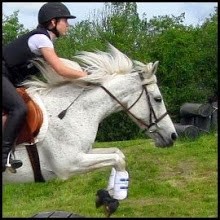
Trotting at Karen O'Neal clinic, 4/19/09


I've been thinking a little bit about what you can do when you ride with a constructive mindset.

Tuesday evening, it was raining hard. In the arena, it sounds loud, no matter how lightly the rain is falling. Pandora had some extra 'go.'

Normally my warmup is pretty relaxed. Walk a little, trot a little, bend a little. This time I decided I needed something to focus on. We started walking serpentines. On the straightaway, I insisted on, well, straightness. Even weight in both reins, even feel between the legs: straight.

It was harder than it sounds.

It felt like she was a pinball going back and forth, almost bouncing between the reins. After a few loops, she understood, and settled in nicely straight. I requested a forward, marching walk -- come on, girl, let's act like we have somewhere to be!

When we picked up the trot, she was feeling the Thoroughbred half of her breeding. That is, she was Forward. More so than she usually is, and more so than I'm usually comfortable riding. I tend to be a little bit of a control freak, because I had so little in the way of half-halts and speed control on my first horse. With Pandora, simply because I can control her momentum with half-halts, I do it too much.

But this time I decided to work with what she gave me. I took that energy and said, "Okay -- let's go." I asked for a big, powerful trot, then asked her to come back to me and compress her stride. I insisted on correct bend. I would push her forward through the corner, accelerate, then come back. We did some leg yields. When we picked up the canter to the good direction, she powered right into it. To the left was still a bit unbalanced, but I'll take what I can get.

The most important part of this was that I came into the ride with a constructive mindset. Sure, she was a little hot, and maybe she wasn't too focused when I mounted up. But I took what I had and I decided I would do something with it -- so we had a really nice ride.

It's important to me to take some benefit out of every ride, no matter how many things didn't go as planned.


I applied the same concept to a clinic I rode in this weekend.

We ended up spending two and a half hours in the saddle - probably an hour and a half in the arena, then another hour on cross country. The arena is beach sand. Lovely and soft, sure. But have you ever gone running on sand? It's hard work.

So I was already stressed about the demands on Pandora's fitness. I know, I worry too much, she's half TB anyway. But that made me a little tense to start with.

Then we rode forever and ever and ever. The clinician was great and had some really good advice, but sometimes it was unclear when we could give our horses a break and when we should keep going.

THEN we went outside. Between struggling to keep a tired Pandora up off her forehand, fighting with her about adequate brakes, and a little confusion about what exercise we were doing, I got pretty frustrated. I did keep my mouth shut and do what I was told, because the way I see it, you go to a clinic to learn, not to argue. ESPECIALLY not to complain that you're tired and so is your horse.

So I kept at it. And you know what? I got some really valuable lessons out of it. Towards the middle of the XC session, I finally understood what she was trying to get me to do with my hands and seat at the base of the fence (I was dropping Pandora, again, sigh). When I started riding right, Pandora started going very very well, as usual.

I found that, even after 2 hours of hard riding in the heat, when I was exhausted and my horse was pretty tired, I could still get around a course of obstacles without Pandora falling on her forehand -- provided I rode correctly.

That is GOOD knowledge to have. That means that when we've been riding for an hour, I know better than to think 'Oh, she's so tired, it'll be impossible to jump without falling on the forehand!'

Nuh uh. I need to start asking more of her. This is a big weakness of mine. I just don't push hard enough.


Anyway, I just wanted to get that out there. There's always a valuable lesson out there, even if you're hot and sweaty and grumpy and tired ;)

Sunday, February 22, 2009

Insights


I love the way sometimes an insight hits you like a ton of bricks.

You've heard people talk about this thing before - maybe all the time. You had a vague sense that you were missing something, but it wasn't that big of a deal. You thought everything was going great.

Then someone says something to you that clicks into place, and WHAM!, you've got some serious new things to think about. I got one of these a few months ago. It was at the catch-riding lesson that I may have described quite awhile back. A fellow Pony Clubber rode Pandora. After we switched back, she said, "You gotta get her to stop off your seat. And get in front of the leg - but she needs to stop off your seat."

"Okay, so...how specifically do you mean stop off my seat?"

"Close your thighs and calves, sit up and stop your back, and make her stop. Just go back and forth from halt to walk. Then you can use the same thing for a half halt, just don't ask all the way."

Seriously. This was the aspect of The Almighty Half-Halt that I'd been missing. Sure, I knew it involved your legs - of course it does! You're recycling energy. Sure, I knew it was a momentary resistance through your back and arms, which your horse immediately responds to, followed by a release.

But I didn't get it.

I worked hard to get Pandora to stop off my seat. Lots of repetition: close thighs hard, hug with calves, straighten up, close hands, halt. Pause, praise, walk on. Lather, rinse, repeat.

Now I have a horse who will halt right away -- BALANCED and SQUARE -- from a walk or trot. I also have a horse who does not rush with me. She gets a little excited in the trot after a canter? I have an instant rebalancing tool at my disposal. I briefly close my thighs and hands, and she's right back with me.

I guess I did something to deserve good karma, because I got another fantastic insight from the clinic I rode in yesterday. In short, she fixed my biggest position flaw. I ride with my legs too far forward. It's always been a habit, and I've never figured out how to fix it. My other big flaw was riding with my upper body too far forward, but my last clinic helped me fix that problem. I stopped jumping ahead. But I could never figure out how to get my lower leg beneath my body without screwing up the rest of me.

This clinician had me bring my lower leg back, and I had to hold it there by really using my thighs and abs. It hurt. And oh boy am I sore today - especially those hip flexors, which really have to open up to hold that position! But I felt so much stronger and more secure. My parents weren't at the clinic, so I didn't get any video or pictures, but Pandora was really initiating forward movement and responding well. We did some low-key jumping, focusing on getting Pandora to really listen to me and make her own mistakes to figure things out.

I will definitely have to practice to maintain the position fix consistently, especially over bigger fences, but I feel like I just took a huge step forward. With this final piece of the puzzle in place, my D-3 Pony Club rating in July will be a piece of cake. She noted that this was really the last piece of the "balanced position" that Pony Club requires, so I'm starting to feel a little more optimistic about possibly rating up to C-1 in September.

From Pony Club materials: "The C-1 and C-2 is a Pony Club member learning to become an active horseman, to care independently for pony and tack and to understand the reasons for what he or she is doing. The C-1 and C-2 show development towards a secure, independent seat and increasing control and confidence in all phases of riding." The fence max at C-1 is 2'9", which doesn't sound big at all, but when you factor in the complexity of knowledge required as well as the fact that they expect your position to be totally solid almost 100% of the time, it's a little more difficult!

Anyway, I'm super excited to work on this position fix. It's the piece that's been missing! Now that I can hold a proper position, I can also work stirrupless. The way I felt before was, if I can't get my legs into the correct spot, won't riding stirrupless just reinforce the bad habits? I'm excited to strengthen my riding by working on this. I'm also thinking I should start some regular fitness, because my abs clearly need a little help!

I'm so glad I went to the clinic, even though I was sick and tired and my parents were out of town. I've kind of gotten my motivation back in the last week or so. Funny to think that so simple of a fix (read: simple does not equal easy!) can totally affect your riding.

You should tell me a story about the last time you had some serious insight whack you in the face, so I don't feel quite so silly.

Monday, January 19, 2009

Clinic Report, Part II

After a nice long break with lunch and a business meeting, it was time to tack up again.

All went smoothly. We began warming up over trot poles, which went fine after the first trip through in which Pandora tripped over every single one ;-)

We built up slowly, just doing small courses of ground rails, then small x-rails. The clinician used the best phrase I've ever heard to get me to fix my problem: "It's like the Wonder Bra - you lift and separate!"

Which is PERFECT for my problem. I tend to hunch forward; if I remember to bring my shoulders up and back, I duck forward with my whole body. If I remember to sit up, I round my back and hunch my shoulders. When I remember this visual, it does both, and it really helped me fix my position. With this and consistently remembering my elbows (just visualizing the crop behind my back does the trick!), I felt a big improvement in my ability to stay out of Pandora's way.

At the end, she just started moving the fences up. They don't look big in the video (they're awfully tall standards) but our last fence measured at around 2'9". Which isn't big, but - considering I'd been treating her as a green horse and never jumped higher than an X - was quite fun. Obviously the clinician was able to see something in her, because she just casually started bringing the fences up and told me to canter in and just jump them.

I had a BLAST.

Here's the short video. Excuse the total lack of sound - it was the easiest option.


I was positively giddy. Which is silly - I knew she could jump. Her previous owner (not the one I bought her from) was jumping her at Novice height before the meltdown. I guess I just didn't think that she'd feel athletic. Over that last fence, she really rounded her back, sucked her knees up high, and gave me a real jump. Her ears perked up, her stride opened up, and I could just feel her going "FINALLY, we jump something real!"

In light of this, I think I am shifting my plans with her to cover a longer period of time. I am starting to believe that she's more suitable for me than I originally thought. My mom suggests that I plan to keep her for at least a year, and I think that's reasonable. We're improving fast now that I'm taking her to all of the Pony Club lessons and clinics - and competition season is starting up, so I'll hopefully be going to the Show Jumping Rally, the Dressage Rally, and the Eventing Rally. There's also an Eventing Camp the week before the Inavale HT, which would be awesome. By the time we hit July, Pandora and I will have put in a lot of miles together!

I'm not relaxing my training schedule, though. I know that if I'm not paying attention, June will pop up before I even realize it, and I'll be unprepared for the Horse Trials. But, I am relaxing a little and taking a view of her more as My Horse.

I know most of you probably thought this would happen anyway! I think I was so caught on the idea of her being a project horse that I just didn't stop and think about the possibility of her being a great horse for me, you know? So we'll see where things take us. Nothing is set in stone, but after that clinic, I'm excited to see where we end up.


PS: I learned so much at the ABC retreat this weekend. I will write up a full report ASAP, or by the end of the week, whichever ends up fitting into my schedule better ;)

Sunday, January 11, 2009

Clinic Report, Part I

I took Pandora to a Pony Club clinic yesterday. I had a fantastic time and made some excellent progress with Pandora. To give you an idea of how happy I was at the end of the day (while Pandora was less than impressed with how much work she'd had to do), here is a visual aid:


Here's the way the day went (and it was a long day: thus, a long post).

Two riders in each session. One flatwork session before lunch, one over-fences session after lunch. About an hour for each ride. More than Pandora's used to in one day, but with a long several-hour break for hay, water, and relaxing in between, she was fine.

First off - I really, really liked the clinician. She clicked with me, and from what I could tell, a lot of other riders too. She listened to what I told her about what I was working on, combined it with what she saw, and put us to doing exercises that would help.

Key: she fixed me before she expected me to fix my horse.

She was big into body awareness, and she helped me fix the consistent problems I have - without me having to tell her what they are. I tend to lean forward, especially over fences; when I try to keep my chest up, I round my shoulders and roach my back, but when I try to keep my back flat, I duck my whole upper body down. I also ride without enough bend in my elbows. She fixed all of this at once by using one of those time-honored pony club 'punishments': the good old crop-behind-the-back exercise.

We didn't get any good pictures, but basically the crop goes between your back and your elbows. Your arms are thus pulled quite a ways back, forcing a bend in your elbows (and making me grateful I had long reins, cause damn, it was hard to reach the reins from there!). It's pretty easy to remember to sit up when you're contorted like that.

It didn't hurt, but it sure made me aware of how much I tend to slouch forward when I ride. Here's a picture of the middle of the crop-riding process (notice she also had us riding without stirrups - the horror!):


You can see in this picture that I'm still a little forward and rounded with my shoulders. It doesn't feel like it looks, and that's the problem: when I was riding like this, it sure felt like I had my shoulders opened and back. Not until I increased the motion until it felt ridiculous did she tell me that I was, in fact, correct. This is why eyes on the ground are important.

She later used the single best mental image I've ever heard to help me fix the derivatives of this problem over fences. Gotta save it for later, though.

Throughout all of this, we stayed on a large circle doing lots and lots of transitions while working on our body position. And you know what? When I sit up and keep my leg on, Pandora's transitions get a lot better. She leans on her forehand. A lot. So this is important, because her transitions usually involve diving to the forehand, not pushing with her hind end. The instructor used "forward into the walk" (from a trot) to help us retain the feeling of forward movement even in a downward transition.

Very cool. By the end, I was getting much better trot-canter transitions than usual, and our walk/trot and trot/walk transitions were just awesome.

Oh, and she also had us do the "bicycle exercise" to get the feel of the sitting trot, which I won't explain to you until I can show you. I never thought a riding exercise could take more careful balance and coordination than the sitting trot...but boy, was I wrong. I was laughing so hard (at myself) during this exercise that I could hardly breathe. I felt absolutely ridiculous. Unfortunately none of it was captured on video, but I promise that the next time I ride, I'll have my mom film some trot-bicycle-exercise for your enjoyment.


Then, break for lunch and other lessons and so on. Pandora got to hang out in a nice comfortable stall with plenty of hay and water.

She looked pretty sleepy.


Then it was time to tack up for round 2. She was not particularly enthusiastic about being tacked up again ;-) But she tolerates me and my Unreasonable Demands.

I'd like to get this up tonight, but I just don't have time to go over the second half of the day - so you can have this part now, and I'll post the second bit (including video of our awesome last fences) in a day or two!
Related Posts with Thumbnails