Showing posts with label Horse Fun. Show all posts

Saturday, January 23, 2010

ABC Retreat - Part I

Last night, Pandora and I went to our first jumping lesson in about three months. Goodness, it's been a long time! She was no worse for the time off, though. In general she was soft and smooth and she certainly hasn't forgotten how to jump.

My position needs quite the refresher, which isn't too surprising. I fell into old habits, popping up on my toes over the fence (ugh) and not being strong in my core to keep my shoulders back. I'm not terribly worried, though. It was a good, quiet reintroduction to jumping and now I know what to work on! I am also sure my dressage lessons will make a big difference.

Without further ado, the beginning of my report from the ABC retreat.


Most of the girls arrived for the ABC retreat on Friday evening. As people filtered in, we'd grab some cookies or cider and start talking about horses (of course!). I got the rare opportunity to talk about horses with girls my own age who have similar interests - we talked about working-student positions, horses in college, moving up the levels in eventing.

After everyone was there, we received a brief introductory lecture from Nancy, our host. She spoke to us about the need to ask good questions in the horse world, especially as we learned from all the guest speakers over the weekend. Asking all the questions - who, what, when, where, why, how - can help us get a deeper understanding of anything. Nancy then divided us up into a few groups and told us to come up with five questions for each of the topics we'd be covering over the weekend.

Here were the topics: Working With Your Vet, Equine Systems, Conditioning, Starting a Young Horse, Equine Facilities Tour, Long Lining, Suitability, and Structures of the Equine Distal Limb.

I really enjoyed that exercise, actually. It got everyone thinking about what they wanted to know, applying each lecture to their own situation. The discussion was lively, with everyone throwing out ideas. Here is a sampling of the questions my group came up with.

What is one of the most common cases you see in which an owner should have called a vet right away, but didn't?
Do the systems of horses differ by breed? How?
How can you build condition in the winter?
What is the place of road work in conditioning?
How do you decide where to situate the windows and aisles in a barn relative to the prevailing winds or sun in the seasons?
How can you use long lining to improve the training of a trained horse?
How do you pick a suitable off-the-track Thoroughbred?

We got answers to almost all of our questions over the weekend, though I never did run into anyone who knew about how to lay out your barn with regard to prevailing weather conditions.


After our question-brainstorming, we headed out to Nancy's garage for our Vet lecture. The room was stuffed with benches and blankets and rugs - pretty cozy, though it was a bit chilly. Hence the blankets.

We went over the Diseases and Vaccinations information I gave you last year, so I won't type that all up again. We also got a list of things Dr. Hoffman says you should have on hand in your first-aid kit:
- Stethoscope (for pulse, or know how to take it by palpation)
- Thermometer with lubricant
- Bandaging materials: cottons, stable bandages, clean absorbent dressing (diapers work!), antiseptic cream like Nolvasan
- Antiseptic cleaner like Betadine soap
- Pliers (to pull foreign objects out of feet)
- Clippers

She says optional but nice are twitch, bute, ice boots, easy boot, and poultice for hooves.

To that I would probably add Banamine paste to give for colic if your vet says so over the phone. And gloves, latex or nitrile. And I like to have gauze on hand for smaller injuries for which you don't need huge absorbent dressing like diapers. And scissors for cutting the gauze.

Even though I had the first part of this lecture last year, I found it pretty valuable. It refreshed my memory and gave me a good opportunity to ask newer, in-depth questions.


By the time this lecture was over, it was about 9:30, so everyone settled down. Nancy's place is very cool - each room seems to spill into another and the house kind of goes on forever. In the back living room there were enough couches that I think seven of us slept back there, plus she had couches in other rooms and extra bedrooms and the like. It kind of felt like a giant slumber party, which I suppose it was, except we talked about horses instead of boys. (This is my kind of slumber party!)

We rolled out of bed the next morning to a yummy breakfast of fresh cinnamon cake, english muffins, oatmeal, cereal, and several other things I think. I, in my perpetual state of 'Yeah, I'm kinda hungry,' am eternally grateful to Nancy for making food available to us at pretty much all times of the day. Plus lunch was this amazing pot of chicken and rice soup that Nancy made from scratch. It was fantastic.

Anyway, after a nice breakfast, we headed out to the garage again for the day's lectures. Nancy kicked the day off with a discussion of horse systems - digestive, cardiovascular, respiratory, nervous, and the like. We talked about how everything interrelates when you give an aid: you squeeze your legs, which sends an impulse to the brain, which sends the instructions back out to the muscles to move. Then there are all the involuntary processes like heartbeat, breathing, digestion, and so on.

We talked about fast-twitch and slow-twitch muscles and the differing proportion different breeds have. Slow twitch fibers are aerobic, or they need oxygen; they primarily correspond to strength and endurance. Fast twitch are anaerobic and produce bursts of speed, but they can only work for short periods of time. Highly relevant to eventers, who must go at speed over distance and terrain!

The different systems also condition at different rates, as we learned later in the day. For example - you can get a horse's 'wind,' or respiratory system, in condition pretty quickly. Same with muscles. But soft tissue like tendons and hard tissue like bones take much longer to fully condition. This is important when we're talking about conditioning for hard, stressful work like riding cross-country.


After that was conditioning with John Camlin of Caber Farm - an excellent lecture. Further reports to come soon!

Monday, October 20, 2008

Pictures!

Here's some pictures from the show -- and by some, I mean a lot. In no particular order:


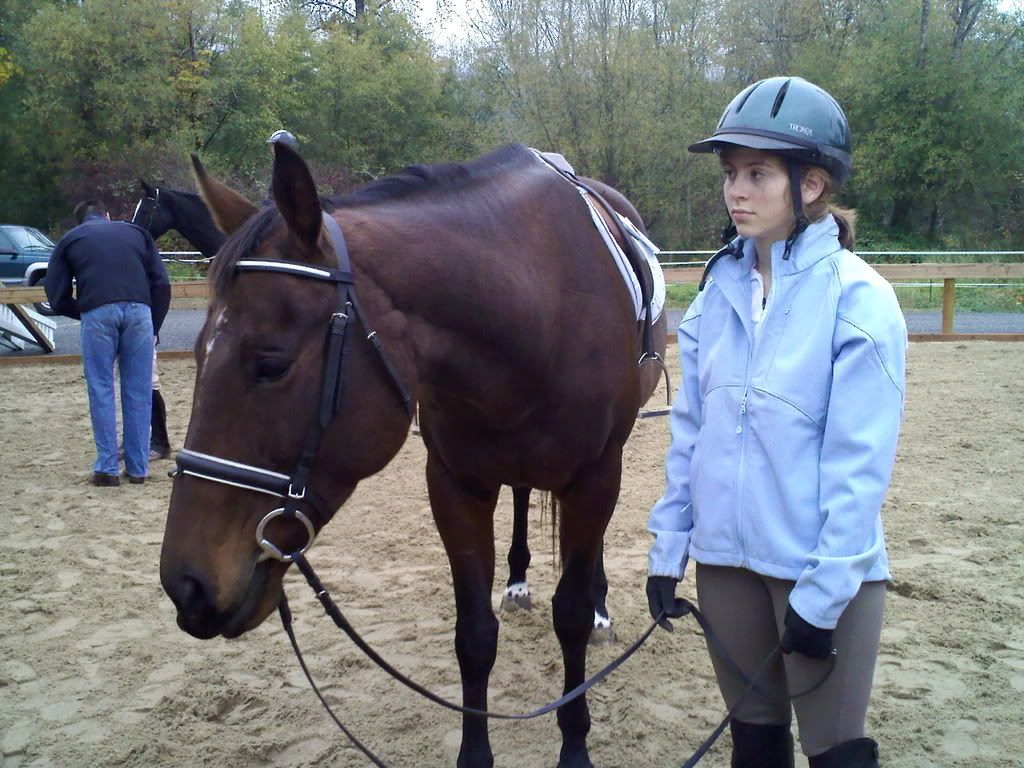
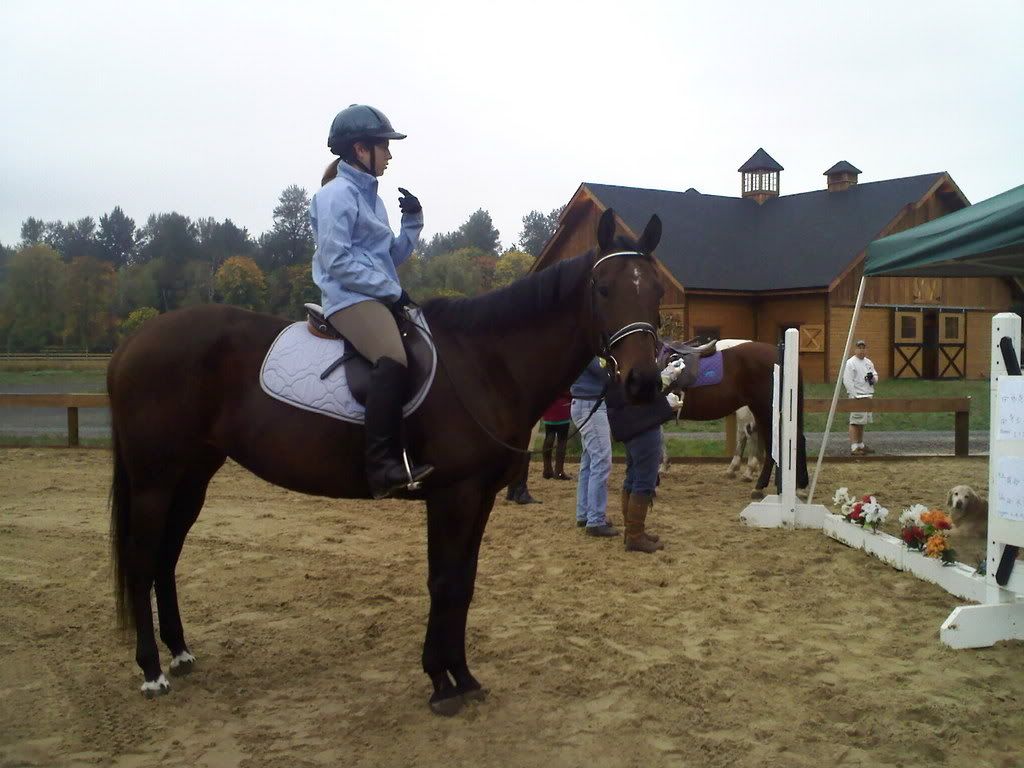
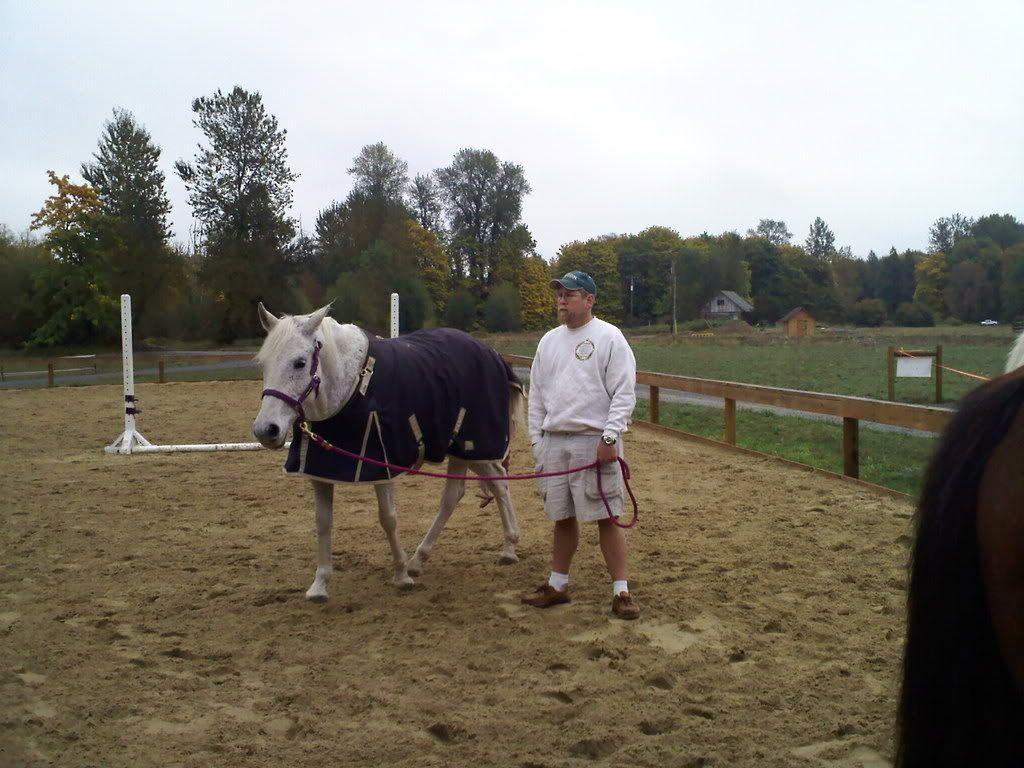
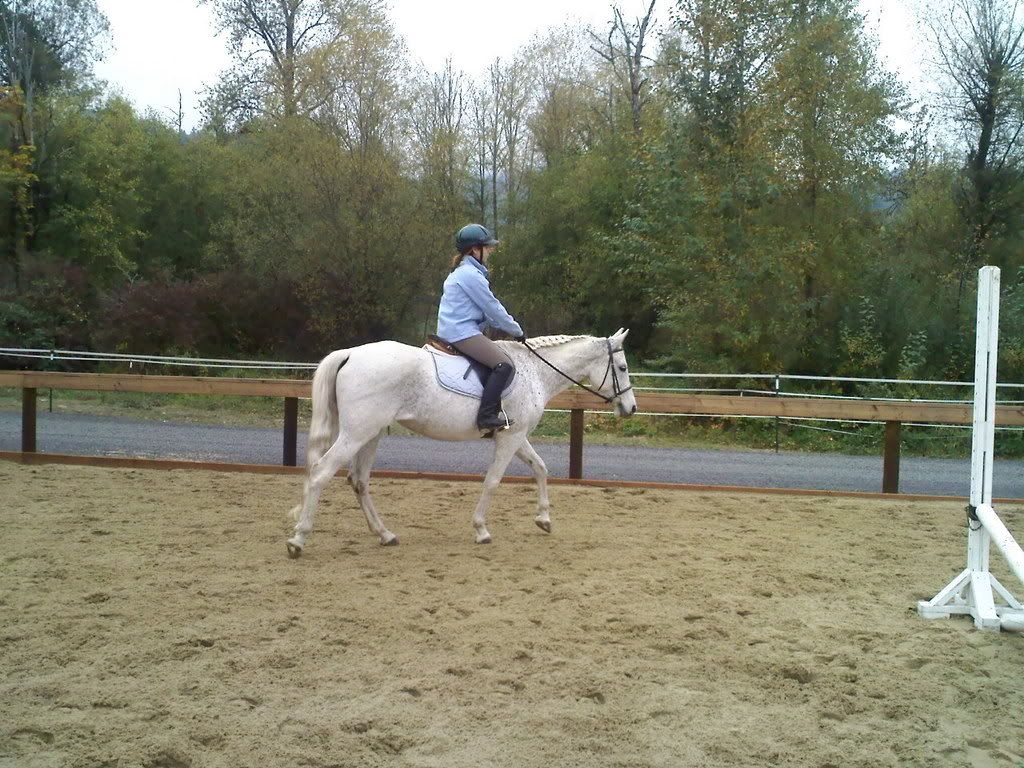
Pandora's attitude for the whole day. Relaxed and chilled out.


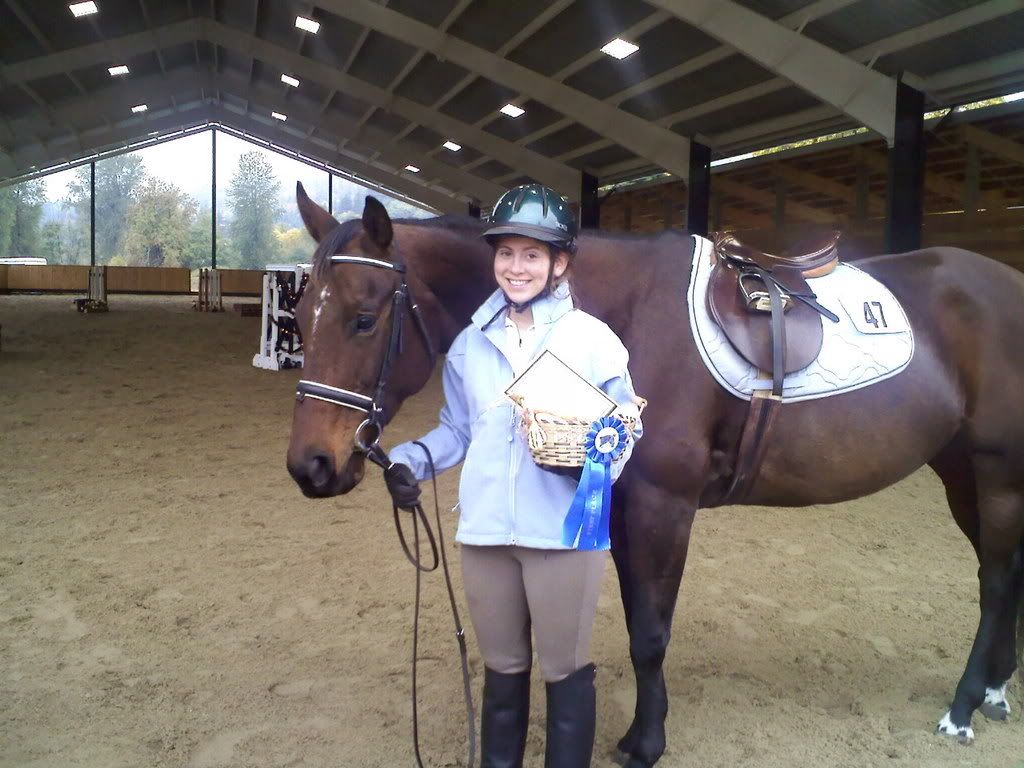
Hooray blue ribbon!


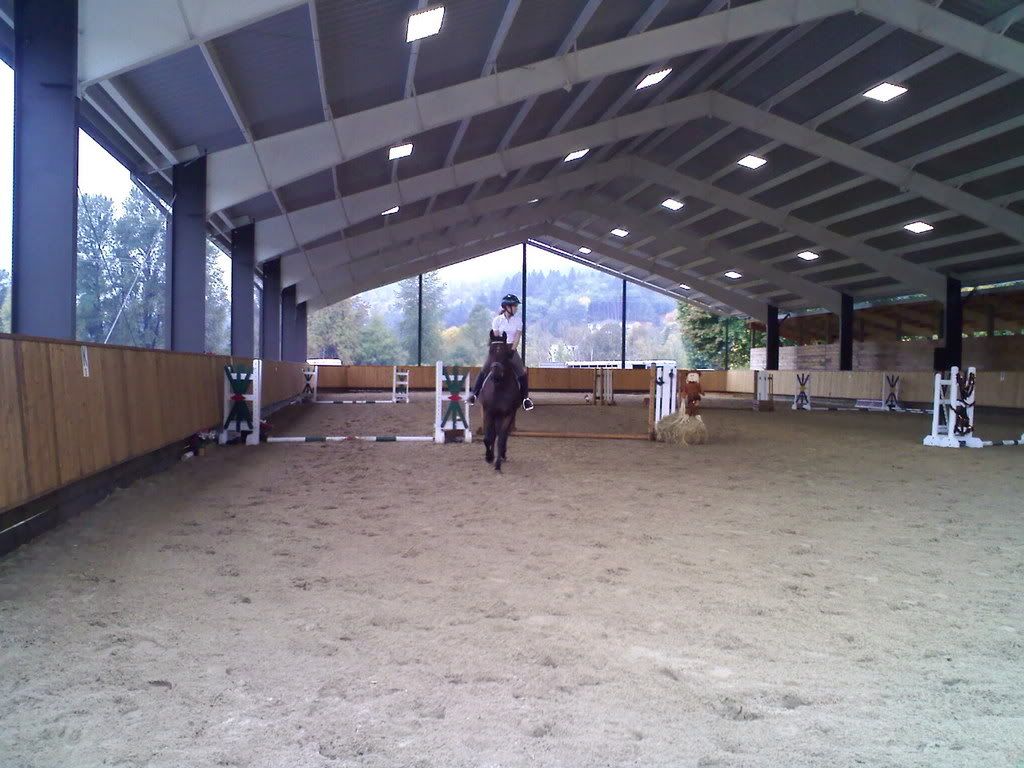
Not much in the way of action shots, sorry guys!


She's cute when she's not being a terror.


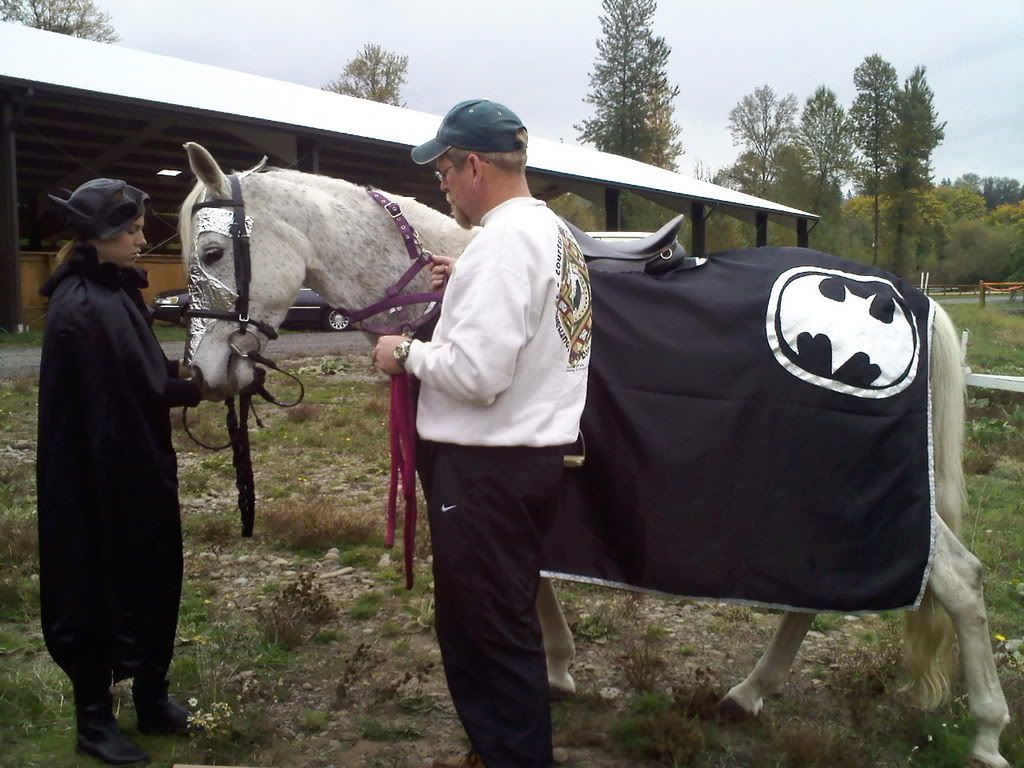
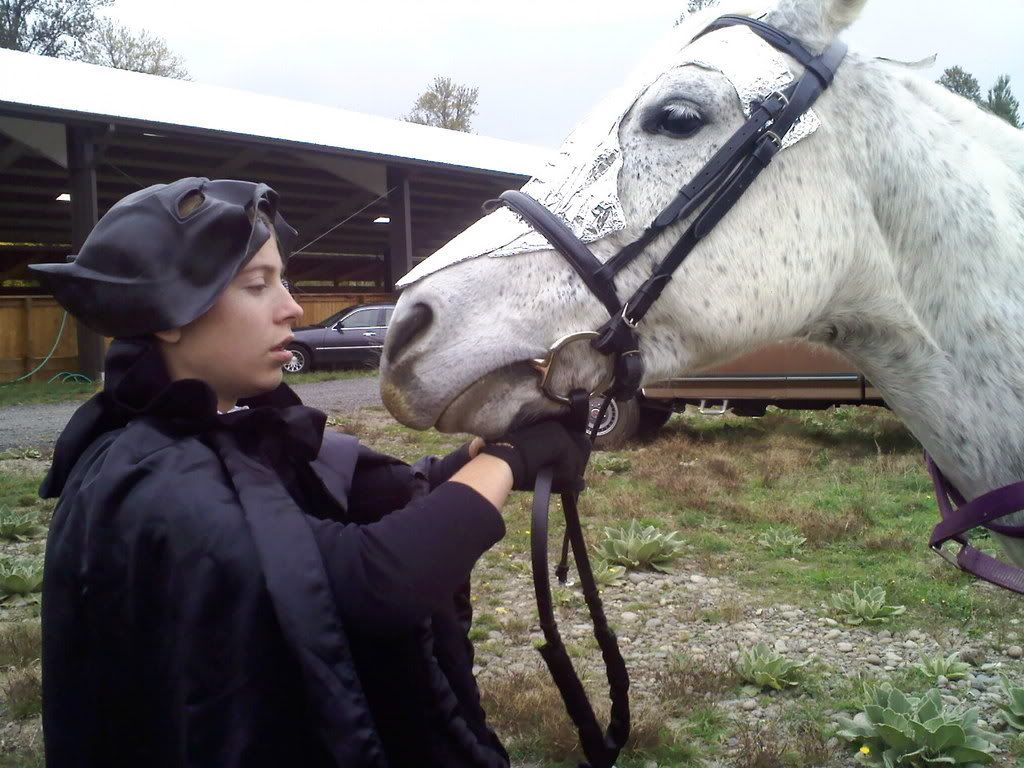
Since I know you all wanted to see it, here's the costume! And McKinna is being very patient as we assemble it.


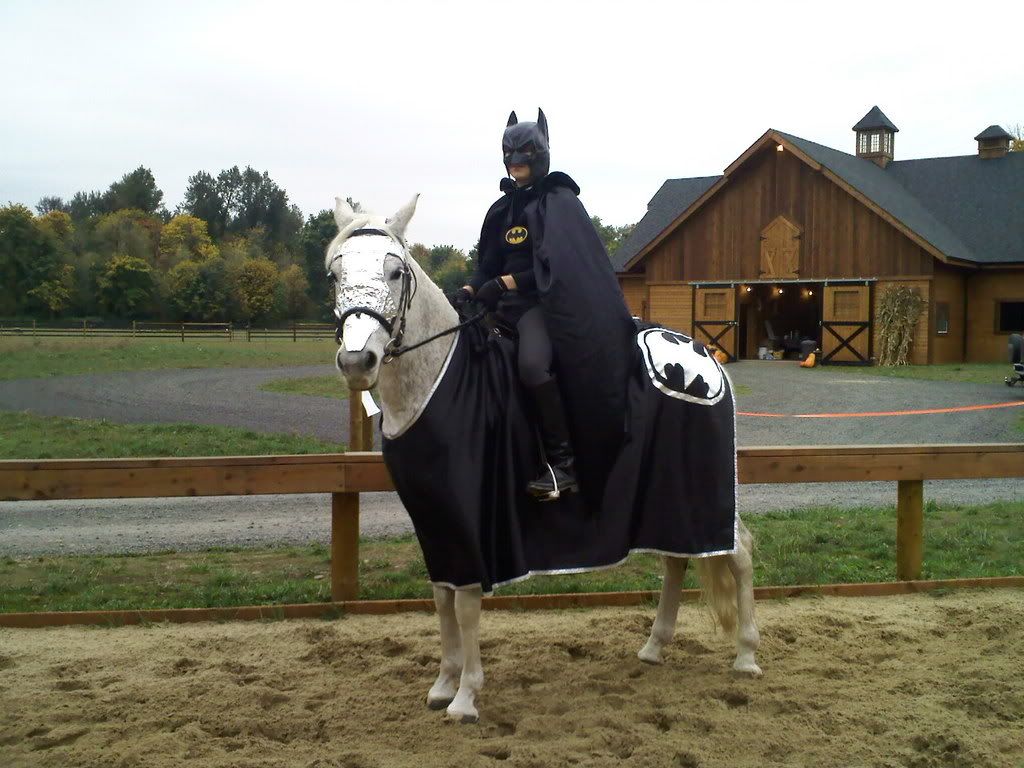
The finished product. I know, we're pretty awesome.


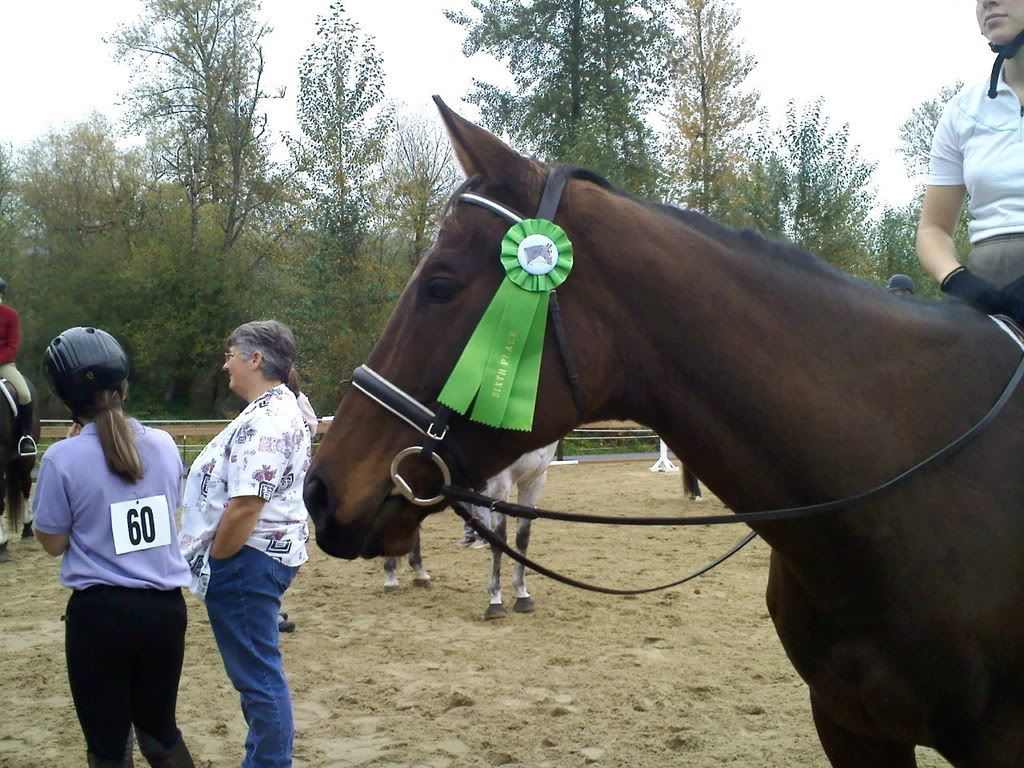
Pandora's pretty green ribbon.


I'm not pointing at myself, I'm memorizing my course :)


And this pretty much sums up McKinna's attitude for the entire day.


She was nice and calm...during warmup.

Oh McKinna, the things you put up with.


So there you have it!

Wednesday, October 1, 2008

Batman, Revisited

McKinna was awesome on Sunday. Mom rode her a little bit and after watching I decided to hop on -- it is much easier for me to explain things as I'm doing them, rather than as Mom is doing them. Also, I was jealous because McKinna was going so nicely!


It's the first time I've ridden McKinna (well, a real ride anyway) since I broke my ankle. My mom laughs at me for the way I keep telling her that she's done so well with McKinna, but it's true. McKinna stepped forward into a springy, energetic walk, and happily gave me a nice working contact on the bit.

So she'd been having some issues with rushing in her trot circles. She would be fine for the first 1/4, then drop her inside shoulder and rush the next half, then straighten up the last 1/4. To fix it, I did this:


Prepare her several strides out with a firm half-halt: gently but firmly close hands and legs and sit deep for a brief instant, all to "check" her and let her know I need her to do something. I begin turning my head to look ahead on my circle; as we near our point of departure from the arena wall, I keep the contact of my outside rein firm (as this is what defines and holds the size/shape of your circle). At the same time, I open with my inside rein and squeeze with my inside leg, while my outside leg rests passive slightly behind the girth, ready to squeeze if she wants to swing her haunches out.


Positioned like this, we go into the turn. The moment she wants to start rushing (maybe 1/8th of the way through, or halfway through the first 1/4), I half-halt again. I'm not shy about it -- if your horse has no reaction to your half-halts, then you need to make your half-halts as strong as necessary to get a reaction. Since McK's been worked so consistently at the walk and trot, it didn't take much.


Here's the key: during these half-halts, I never let her off the circle I wanted to be on. Between my outside rein and my inside leg, she simply could not avoid my path. I checked her several times, each time doing so before she fell apart and started rushing. To clarify, by 'check' I don't mean a quick bump on the reins. I mean a measured whole-body pause, where I squeeze my reins and close my legs and sit up tall and deep. It's a smooth movement, but brief.


While this gave me a bit of a lumpy tempo (steady, speed up, check back/slow down, etc) and her head was a bit raised in response to my very firm insistent outside rein, it also gave us a smooth path and made it extremely clear to McK what I wanted. She tries to deviate from the circle, I force her to stay on it with my aids. She wants to rush, I half-halt and stop her. These two go hand-in-hand, since rushing often leads to dropping the inside or outside shoulder and thus losing a smooth path.


In the last quarter of the circle, she gave me what I wanted. She relaxed her head down, accepted a contact with my hands, and started truly pushing from behind. This was a very, very tangible change; I felt it immediately as her cadence steadied, her back rose, and the "air time" between her steps felt longer. My mom saw it instantly.


When this happened, I quit messing with her. Yes, she started going a little faster as this happened, but that was because she was using her hind end to push. The increased speed still had a steady rhythm, her back was still lifted, and she was still relaxed in my hands. My very steady hands, accompanied by a steady seat and steady leg. This is key. When she gave me what I wanted, I didn't need to half-halt, to hold her on the circle with my outside rein, or to constantly remind her to bend to the inside with my leg. She held the path. She held the bend. She kept her rhythm. All I did was give her soft, supporting hands, a supporting inside leg, and a LOT of verbal praise. You'd think she just painted the Mona Lisa, the way I carried on.


The next time we circled, it only took her half the circle to give me that feeling.


It's an amazing, amazing experience, let me tell you. To feel her suddenly shift her entire body, using it correctly, and moving in perfect communication with me, like a steady quiet dialogue was going on between the reins and my seat -- that was cool.


It's happened before, but never that easily.


So after I explained all this to Mom, she got back on and was able to reproduce that same sequence of events: prepare for the circle, hold her to the path, half-halt as often as necessary, and when she responds, go with her. It was really lovely to watch.


I'm very proud of the progress McKinna has made in this. It's truly wonderful to ride that feeling.


That being said, what is with the title of this post, you may ask?


I'm so glad you asked!


There's a Halloween schooling show at a local barn this month and one of the classes is a COSTUME CLASS. I bet you can guess where this one's going...

Yes, that's right, I am going to drag the Batman outfit (see post here) out of the closet. In fact, McKinna, as the Bathorse (did he ever have a horse? Don't think so, but oh well) will get costumed as well. Here are the details we've thought of so far:


A black sheet to go over her main body (like picture below). I want to put the Batman logo on the haunches.


Black dressage saddle and bridle, obviously.


"Warhorse" armor, made out of tinfoil that is painted black. Probably much the same pieces as on this horse from Warwick Castle:


i.e., a forehead-down-the-nose plate (probably not going all the way down the cheeks and all), scallops over the crest, and possibly a shoulder guard. It all depends on how difficult it is to make all of that!


The other option, of course, is to make her a My Little Pony. She is white and cute and would look phenomenal with pink [mane, tail, hooves] and glitter all over with glittered hooves and the like. Mom wants me to go with this outfit (and I can't deny that she would be unbearably cute, especially with wavy mane/tail) but I really can't decide. To be badass, or to take the perfect excuse for getting her all girly and pink? Either way I'll figure it out soon and I am excited to get all dressed up!

Tuesday, July 22, 2008

The Cake Walk

I'm a bit too tired to recount my talk at leadership camp right now -- been pretty busy lately, but I promise I will tell it soon. To hold you over, here is the story of the now-infamous Cake Walk that used to be an entertainment activity at OHSET (equestrian team)!

It was held on Friday nights, I believe, before Grand Entry. Or something. It was a fund raising event; each team was asked to bring a cake to be auctioned off, and all the money was put into the pot. The total money was split: half to the team that came up with the idea and set it into place, and half to the team that won the event.

Anyway, it went a little like this:

Each team selects a member representative. Generally chosen are the daredevils with really, really fast horses. In the center of the largest arena, they set up a giant circle of cones -- one less cone than there are riders. They play music as everyone lopes around the perimeter of the circle. When the music stops, the riders stop, jump off, and grab a cone, though stopping before jumping is sometimes skipped. One rider is left without a cone, they're out, and so it goes.

Not too bad, though sometimes people trip and fall going after the cones. The center circle gets smaller and smaller as more people are eliminated.

Then there's two people left.

They put one really big cone in the middle. Dead center. They tell the two remaining people to gallop around the whole outside of the arena. When the music stops, they both gallop hell-bent for leather towards the center to leap off and grab the cone.

Two people galloping towards each other on gaming horses, both dead set on grabbing that stupid cone! Yay!

Dangerous? Oh hell yes.
But my goodness, it was exciting to watch!


Needless to say, the Cake Walk was discontinued rather quickly.

Sunday, July 6, 2008

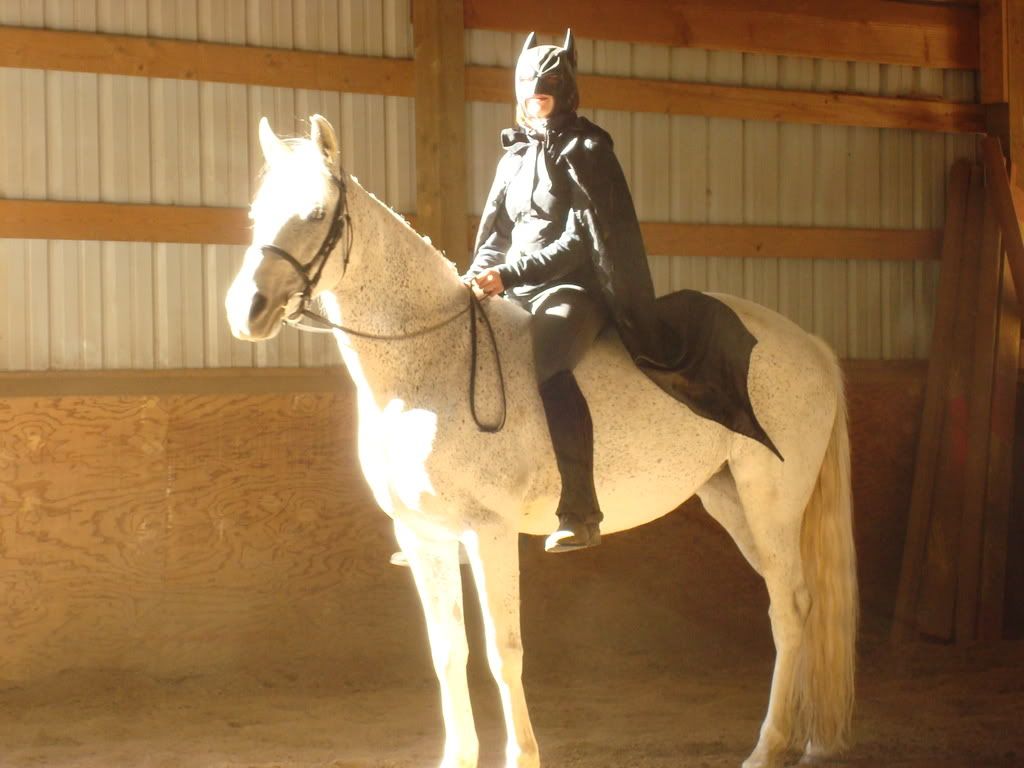
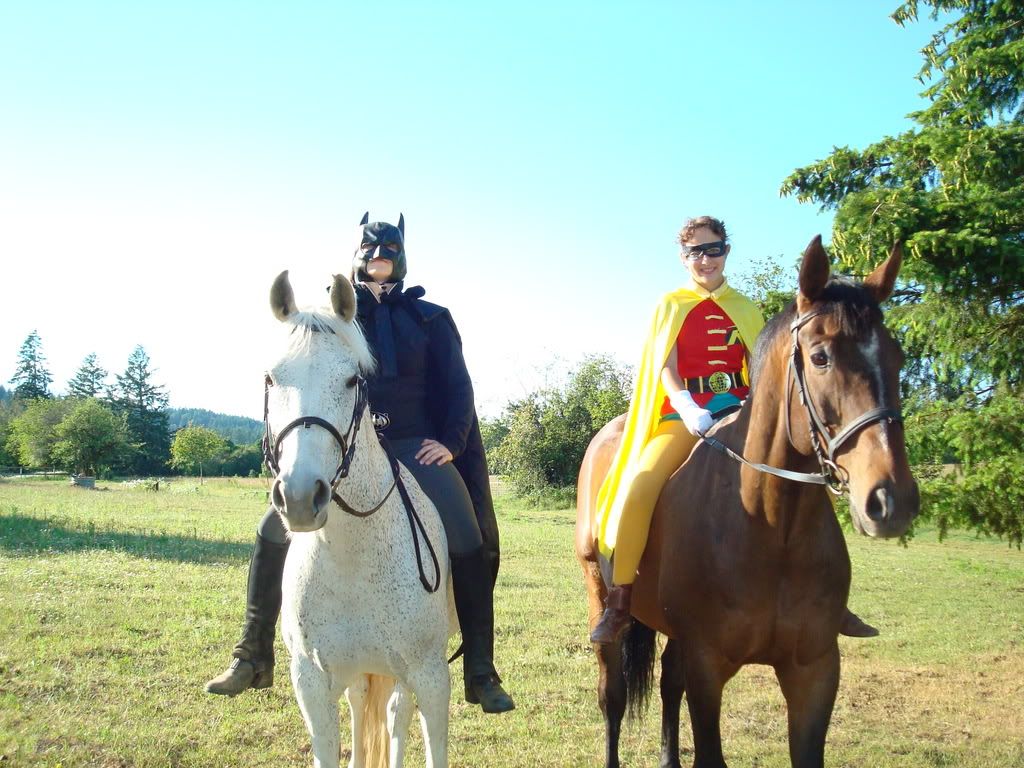
Batman on Horses

Okay, so I told you there was a reason for me riding my horse in a Batman costume, right?

Well, there is a reason.

In addition to riding horses and trying to kill myself with really advanced classes, I also am/was very active in the band. I played in our top jazz band, in our wind ensemble, and during the marching season, I was drum major. My most visible job as drum major is standing up on the podium conducting the band during performances -- but my most important job was being student leader of the band, teaching rookies things, leading rehearsals, organizing things behind the scenes, blah blah blah. All that stuff that looks good on a college application. It's a very hard and occasionally thankless job (hmm, sounds like horses!) but I loved it very, very much. There's not many places you can get that kind of experience, teaching and leading your peers. Mmm.

So anyway.

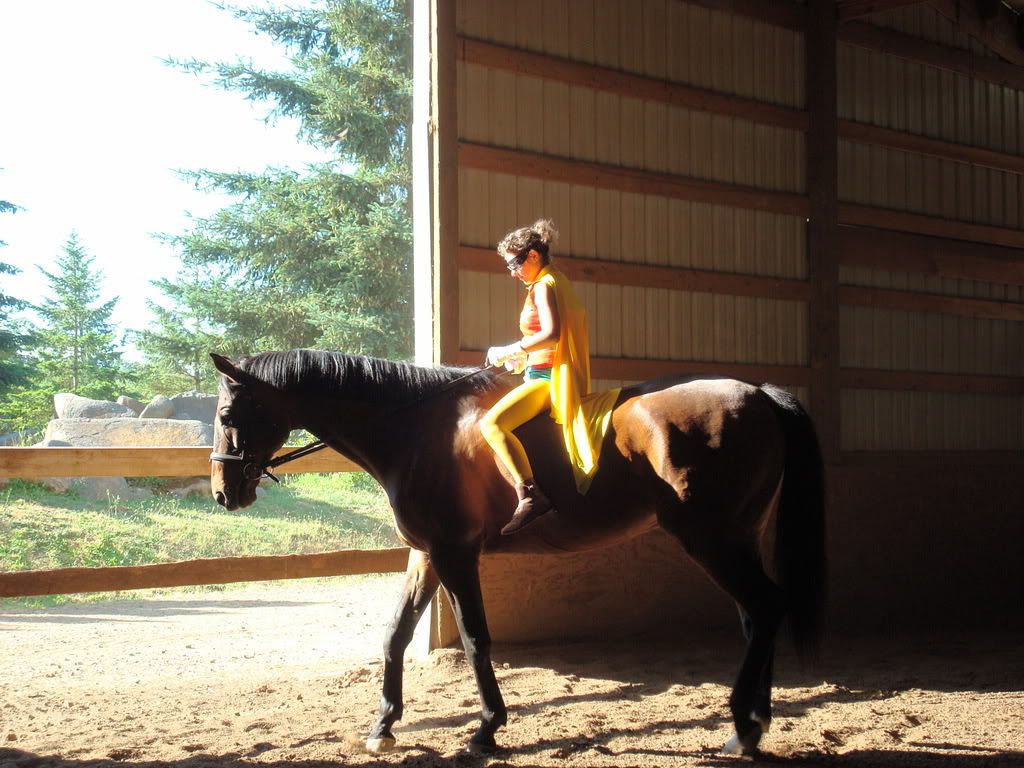
The drum majors often dress up to suit the theme of each year's marching show. This year we did music from Batman, so I dressed up as Batman and my co-DM dressed up as Robin. I assure you the cape effect was very dramatic when one of us ran between podiums. Conducting with a cape is also very cool.

Why we decided to get pictures on horses, I'm not sure. A coming-together of the two halves of my life, I suppose. Band and horses.


So it ended up that my friend and I pulled on the old gear (it's really weird -- I hadn't worn that stuff since the marching season and it was rather nostalgic), and saddled up. Only we were bareback, so I suppose we bridled up.

We were going for the backlit dramatic look.
First up is my partner, Robin, on Loki (Rose's horse):

Then the Dark Knight on the white horse:


The two of us together out in the field:


I think this is one of those Stupid Kid Moments that people talk about. It's the only time I can remember riding a horse without a helmet. Also I was wearing a mask that severely limited my peripheral vision. Also I had a Big Flapping Cape.

Which neither horse minded, I might add. I was quite proud of both of them!

I also took each of them for a bareback canter around the arena. Just to, um, make sure they were okay with the capes.


Cantering bareback with a cape is FUN. Your cape goes all flowy in time with the strides. Mom got a video -- I'll have to post it sometime.


So, there -- Batman on horseback. I told you my horse puts up with a lot!

Saturday, July 5, 2008

Long Reining, Round 2

So tonight I brought out the nice new caveson and played around with long reining some more. I really should ride her since I'm leaving tomorrow for a week (don't worry, I've got some posts scheduled, but I won't be replying to comments).

Here's how the night went.

Mom took her out of her stall and tied her. I went into the tack room and grabbed caveson, surcingle, two longe lines to serve as long lines, and the top half of a two-part whip (perfect for long-reining -- it's light but the lash itself is serviceably long).

I swear she rolled her eyes at me.

At the very least, she heaved a big sigh and stood patiently while I adjusted the caveson (needs to be a bit tighter in the jaw straps I think, it slipped a bit) and put the surcingle on and threaded the lines through.

Patiently, she followed me into the arena, and perked her ears at me. This is McKinna's trademark Arab Face, as in "Okay, you've gone off the deep end again, and I'm somewhat interested in figuring out what the hell you're doing."

So we set off with some walk-trot circles, figures-8, serpentines, and general loopy goodness. She did really well. The disadvantage of working in both directions in one session is that both reins are attached directly to the caveson, run through the surcingle rings. I like it better when the inside rein is run through the caveson and clipped to the surcingle, because it's less direct and encourages them to relax into the bend rather than resist, but then you have to switch it every time you change directions. So we managed.

Then we both got bored and she was doing well, so we went for a walk outside. Down the hill, around through the weeds while she patiently turned and stopped and circled, then a bit of walking in the outdoor arena and we called it good.

In any case, I am really enjoying this long-reining stuff, and for all her disgusted sighs when she sees the tack come out, McKinna seems to be enjoying the mental challenge.

Pictures!
Isn't that field behind our arena gorgeous? It's massive, it's gently sloping, and I covet it SO SO MUCH. It's wasted with cattle on it, I tell you.


As always with one ear on me and one on the lady with the camera.

I didn't mean to aim her between those two frisbees, by the way. They were just there and we happened to go through them. See what I mean about the strap sliding a little, though? I think it's a bit too close to her eye.


Tomorrow: the promised Batman Post.

Following that, there'll be posts about my lesson the other night, the story of the first time we trailered Bailey to an OHSET practice, a description of the now-infamous "Cake Walk" event that OHSET once held, and teenager-glee about the Eventing camp I'll be going to in the beginning of August.

Thursday, July 3, 2008

Long Night

Tonight's been a long night -- I just got home from working the Elephant Ear booth at the local rodeo. Our equestrian team (my high school's, that is) runs the booth as a fundraiser and let me tell you, it makes pretty much all the money for the whole year. It's a sweet deal (ha, no pun intended). I got to watch quite a bit of the rodeo. I alternate between watching the bull riders or bronc riders, and admiring the horses of the riders who catch or herd the bucking animals afterwards. Damn, those are some nice horses. Especially the ones they use to herd the bull. I mean, really? How many horses do you know that will calmly go after an animal that probably weighs more than they do, and is bucking, and has horns, and is really really pissed off?

In any case, that's why I'm a bit tired for a real post. I'll write a post tomorrow, either about why I rode my horse in a Batman costume or about my lesson today, which went really well.

But to tide you over for the night, here is the reason you never hose off a gray horse and put her in the arena:


Thankfully, I hear most of it brushed right off. Mom took this picture while she was at the barn last night. Aside from the fact that the angle makes her head look so whonking huge, it's not a bad picture for a cell phone camera, eh?

Wednesday, July 2, 2008

Equestrian Team

So here's why participating in Oregon High School Equestrian Teams (or OHSET, if you don't want to tie your tongue in a knot) was really, really good for me and my horses.

There's something like two hundred riders. Lots of them have more than one horse.
Therefore, your horse gets introduced to crazy warmup arenas. Big time. After the first meet, Bailey was an awful lot less concerned when A. people tried to run their horse up his butt, B. horses went flying by bucking wildly, C. people with flags galloped around playing tag, or D. miniature ponies with carts were about.
After a few minutes of sensory overload, the horse generally starts ignoring all the other asshats and just listens to you.

You haul to practice once a week and you haul to three meets, once a month in the winter/spring. This provides a very nice incentive for your horse to learn to trailer nicely, doesn't it? And how convenient that you get weekly practice! By the end of my time with him, while trailer loading could still be a high-stress experience simply because he was never quite happy being shut in, Bailey would pretty much walk right on the trailer. With McKinna this has never been an issue.

Did I mention the asshats? People will cut you off and glare at you. People will see that you accidentally crossed your reins before you put them over your horse's head and say nothing. People will roll their eyes if your horse misbehaves. They will also run their misbehaving horse into you in the warmup arena. Their training methods are right, and yours are wrong. Also, if you don't want to wear a neon-colored helmet cover for dressage, you have no team spirit and are a Diva. After awhile, it all rolls off your back, a valuable skill to have anywhere and especially in the horse world.

Then again, there's also nice people. Making friends from other schools, spontaneous bonding with people who I empathize with ("Yeah, I have a crazy horse too..."), people who loan you tack and rule books and horses and help you with your patterns, people who offer a free spot in their trailer, people who cheer for you even though they don't know you. Life's not all that bad, is it?

You are expected to compete in 5 individual events and as many team events as possible. This is so your team can get as many points as possible. You're an English rider and there aren't 5 English events? Guess you'd better learn to ride Western then. My three safe things were Over Fences, Hunt Seat Equitation, and Dressage. With both Bailey and McKinna, I have competed in Pole Bending, Individual Flags, and Figure-8 for individual events. I also learned how to team pen, do Canadian Flags, and run Birangle. Another popular event, IHOR (In Hand Obstacle Relay), which I stepped in to do after a team member quit, involves showmanship at speed over obstacles.

Basically, doing all that different stuff means your horse had better be one hell of an all-around horse. My horse neck reins very well, grasps the basic concept of pockets though I never patterned her, understands working cows in a team, and gets really, really excited when we're about to run Individual Flags. She already lead well before I started OHSET, so I wouldn't have worked on it; thanks to competing in IHOR, she can flawlessly (and quickly) turn on her forehand or haunches, sidepass, trot in hand (on the off side too!), or back through an L, all without me touching her. She also stops dead on a dime.

Here's some pictures to illustrate the different sides of it all (these were all taken at OHSET):Lining up for the sidepass in IHOR


Getting ready to carry the flag for Grand Entry


Team Penning (sorry Mugs, I'll never be as good as you with cows ;)


We're serious about our pole-bending. Really.


Just trying to keep a gray horse clean!


That's all for today!

Monday, June 30, 2008

Long Reining: Experiment #1

Okay, so instead of writing about tonight's jumping lesson (which involved very little jumping as the mare was a few fruit loops shy of a full bowl), I'll tell you about experiment #1 with long reining. I'll tell you about my lesson once I'm a little more cheerful about the situation. Especially since I just spent a post talking about how wonderful she is and how we're thinking of breeding her. How ironic.

In any case, here's the story of the long reining extravaganza. I just finished reading Philippe Karl's book on long reining, which I highly recommend. It's very concise, easy to understand, and has the aids nicely explained along with beautiful photographs to illustrate. It was a joy to read.

Some minor equipment issues that I was already aware of:
  • Our longeing caveson is too big for her. This is because we bought it for Bailey, who had a Thoroughbred-sized head, and McKinna has pony-sized head. It doesn't slip wildly around, but it's not snug.
  • I don't have long reins. Ideally you want about 5 feet of round cord with snaps at one end, and the other end of the cord tapers out into many many more feet of flat cotton line. I used longe lines, one on each side. They didn't slide very well through the rings on the caveson, but they worked passably.
  • We don't have a surcingle. I borrowed a friend's, so that wasn't too bad.
Said equipment issues should hopefully be fixed soon, since my mom just ordered a nice pony-sized leather caveson. Next item on the list is some nice long reins, and finally a surcingle. Aren't new equestrian ventures fun?

So the pony (who was, unlike her resistant self tonight, quite cheerful that night) stood patiently while I set up a longe line on each side. On the inside, you run the line through the bit and clip to the surcingle; for the outside, you run it over their back, through the surcingle, and clip to the bit. That way the inside line is softer and acts as an opening rein instead of a direct rein, which can cause resistance for the horses that aren't used to it yet.

So up we hooked and away we went!

It was a bit laughable, to tell the truth. We just did walk-trot-canter on a circle, with me trying to coordinate two longe lines and one whip (three hands would have been nice) and her trying to figure out what on EARTH I wanted her to do (hence title: misadventures). Since my saintly horse knows full well what to do on the longe line, she just trucked around trying to listen to the reins. It worked pretty well, though I have a feeling that our communication will vastly improve with proper long reins.

I think I will wait to try again until I have at least a proper caveson. I'll continue just working her on a big circle until I have the right equipment, she's a little more comfortable with it, and I'm more familiar with handling that much stuff at once. After that, we'll switch to direct rein on both sides and start practicing me driving her from different directions, moving to a change of rein at the walk (where she's bent in one direction, then as I cross behind her she switches the bend as she moves in the new direction of travel).

I figure if I can get to where we are proficient at shoulders-in reversed and shoulders-in, that's pretty good. If I can get to the elementary stage of half-pass (which is like shoulders-in reversed, only they are bent to the inside), I will be pleased as punch. Shoulders-in is an immensely beneficial exercise, and I think doing it from the ground will be very, very good for both of us. First, it removes a complication by taking the rider off the horse, making it easier for the horse to balance itself. Second, since for that exercise alignment is crucial, being on the ground lets you very easily see whether your horse is doing it properly. Third, since you don't have seat or leg aids, you need to break it down for your horse and get your horse responding to your voice, body language, and rein cues. All in all, an exercise in thinking hard for both horse and rider -- you can't box your horse up between reins and legs and pretend you're doing it right.

It is, as the French would (probably not) say, très cool.

Sunday, June 29, 2008

Watching The Big Dogs

So yesterday, the whole group of ladies went to Inavale to watch their annual Horse Trials (HT). We went to watch the Intermediate level, which is one step below Advanced (the highest level). For some perspective, here's some of the specifications for the fences on XC:

  • Optimum time should be 550 meters per minute (about 20 mph), so this is their average speed
  • Fixed fences are a maximum of 3'9", brush fences max 4'5"
  • The max depth (like an oxer) of the top of a fence is 5'3"
  • Drops (jumping down off of a ledge) can be max 5'11"
So keep in mind that there's another level higher than this...

It was pretty damn impressive. When we first saw the riders, they were coming out of the woods. On a pretty steep downhill, they jumped three logs/drops in a row (a fence in front of a drop), then made a hard right turn to another fence and into the neighboring field.
We could walk around to see the neighboring field, where they'd jump a few fences, come around, go up a hill, jump two fences on top of the hill, go down, through water, jump up a bank out of the water, over a fence, hard left turn (almost 90 degrees) to a fence that was in front of a drop to the water (so they jump up, and land further down in the water), then out of the water and over a narrow fence and away.

It gave me chills. I think I actually teared up at some points, it was so intense. After they did the water complex and a few other fences, they came galloping past about 10 or 20 feet from us. There is so much power in those horses.

All of the people I ride with were going "Wow, that's amazing...they're crazy."

I was going "Wow, that's amazing...I want to do that."


I know McKinna doesn't have it in her to go Intermediate or probably even Prelim (next level down). But I'll take her as far as we can both go.

And boy, do I have big plans for future horses.

Fussing

Okay, I admit it: I love fussing over my horse.

I will happily spend hours grooming. I will lovingly curry all over, brush the dust off, curry again, brush again. I will go over the whole body with a slightly damp washcloth. I will cheerfully clip the bridle path, muzzle, and fetlocks. I love pulling manes (though we leave McKinna's long), and I will wash, braid, and bag tails all day long. I will detangle the mane and braid it if it's long. I will get a washcloth and clean eyes, nostrils, whatever.

I have a book called Grooming To Win that I love. It details every aspect of seriously intense grooming as well as all kinds of braiding and such.

Some of it I've learned to love out of necessity, because McKinna's coat is white. It quickly turns yellow if you don't keep up. Hence, her tail is always braided into a three-tube tail bag. If not, it turns yellow and stays yellow. You'll notice in pictures that her tail is often wavy -- that's why. I probably give more baths to her over the winter Equestrian Team season than Bailey got in his whole three years with me.

But some of it is just fun. I've been trying to tame Chaucer's mane, which involves washing it or getting it wet, brushing it all over to one side, and braiding it down. A few days later when the braids are looking messy, I take them out, brush it out, pull the mane from beneath, then repeat the whole thing. His mane is rather unruly and likes to grow on both sides of his neck, so this is a fun challenge.


The reward is in the beautiful long thick tail, the healthy coat, and the very white horse when we go to shows. The downside is trying to wash an impatient horse's legs and tail in the middle of winter because we're not going to a show with a brown and yellow tail.

I love horses.


On another note, my books arrived on Friday! I've been devouring them, and I've certainly learned some things. While I know that neither I nor my horse has the potential to school piaffe and passage on the long reins, I think it's fairly realistic to expect that I can teach her shoulder-in from the ground using long reining, which I think will be a really fun challenge.

Tonight when I go out to the barn, we're going to start with the first steps, which is just basic navigation using the longe caveson and surcingle and two long reins. I'm quite excited!

Sunday, June 22, 2008

Ugh.

Hmm. Did I say that camping Friday through Saturday and then going to a schooling show on Sunday wouldn't be tiring?

Ha. Who was I kidding?

The horses were just fine, but I am one tired kid. Yes, you crazy people who get like five hours of sleep per night notwithstanding, I really really need about 8 hours of sleep a night. 9 is ideal, but my body can't handle less than 7 for a few days at a time or I get really cranky and start to get sick. In any case, both camping and the show were quite fun!

A quick overview before I go crash for a nap:

Camping
I had a blast where we went. It's a state park in Salem, and they have campsites that fit four horses and two tents (though really there's plenty of room for that and more). Since we had five horses and seven people, we took up two adjacent campsites. McKinna was awesome on the trail - just truckin' along being the lead horse, totally fine with all of it except the occasional downed log in the underbrush. For whatever reason, she really doesn't think that big chunks of wood belong in all the bushes and stuff. Don't ask me why, but without fail, every time we passed big pieces of wood in the brush she'd scoot sideways a little and look at it like it came from the moon. Other than that she was good. The rest of the party had the occasional panic issue, probably because the trail was single-file and a bit windy through the woods. There was some bucking and some all-out meltdowning (at the end one of our riders got off to walk for a bit because her horse just lost it), but the majority of the ride was quite nice.

For me the only unpleasant part was the heat. It was just downright muggy - hot I don't mind, but humid sucks. All the horses were pretty wet by the time we were done (except McKinna, who was only a little sweaty under the saddle pad - do I get to be proud of that?). They all slept cheerfully in the corrals and we went for a short ride the next morning with no issues at all.

Show
We ended up taking only Chaucer and McKinna to this show. I did Intro A and B on Chaucer and A on McKinna, then Mom did B on McKinna. All in all it was a very successful first show! We ended up with some ribbons but those hardly count at schooling shows (especially when they score juniors separate and I was one of very few people under 18!).

The real victories were in the rides, though. My first ride on Chaucer was alright - not bad, not good, but still a definite improvement over past rides. Generally inverted and counterbent, but I'm looking for the right gait and the right general direction, here ;)

My ride on McKinna was . . . stressed. I didn't give myself enough time to warm up. I KNOW better, but I did it anyway. The test itself was actually pretty okay, and I got some nice moments, but I know it would have been way better if I'd taken the time to walk and trot for about twenty minutes before I went in.

The awesome part was in Intro Tests B, though! I went first on Chaucer and I was just blown away by how good he was. His lines were straight! His free walk was stretchy! His trot across the diagonal was downright powerful! Our weak spots were the trot circles, where he lost focus and wanted to go fast. But my goodness, I was so happy with him, as I'm sure you can tell by the exclamation marks ad nauseam! That trot across the diagonal was really something. He reached into the bit, brought his back up, and was dead-on straight. It made me really itch to bring him along further just to feel what his trot lengthenings and extensions would feel like.

Last up was my mom on McKinna, and that little horse was just a saint. For my mom's first dressage test ever, she trotted around relaxed and calm, reaching into the bit, marching along at the walk, and halting perfectly on the centerline. From a horse that normally gets so anxious she trots around at warp speed with her head flung high, that's pretty darn good! My mother, by the way, was also pretty awesome.


So all in all the weekend was a great success, and I am off to bed.
Related Posts with Thumbnails